

Table of Contents
- What Is Solar Heat Gain and Why It Matters
- Understanding the Solar Heat Gain Coefficient (SHGC)
- Step 1: Install External Shading Devices
- Step 2: Apply Window Film for Heat Reduction
- Step 3: Optimize Window Orientation and Building Siting
- Step 4: Use Radiant Barriers and Thermal Mass
- Step 5: Leverage Vegetation and Landscaping
- DIY vs. Professional Installation: Cost-Benefit Analysis
How to Reduce Solar Heat Gain: 7 Proven Methods
Last Updated: July 28, 2026
Solar heat gain, unwanted thermal energy entering your home through windows and skylights, accounts for a significant portion of summer cooling loads in desert climates. At SPARKLE TECH SUN SCREENS, we’ve helped hundreds of homeowners tackle this challenge with proven strategies, from external shading devices to smart window upgrades. Below are seven approaches that deliver measurable results and strong returns on investment.
What Is Solar Heat Gain and Why It Matters
Solar heat gain is the process by which solar radiation passes through windows and converts to thermal energy inside your home, raising indoor temperatures and forcing your air conditioning system to work harder. Homes with uncontrolled solar heat gain can see cooling costs spike 20-30% during peak summer months compared to homes with proper solar control measures.
Solar radiation arrives in three forms: direct sunlight, reflected light from surrounding surfaces, and diffuse light from the sky. When this radiation enters through clear glass, most converts to heat rather than useful light. The building envelope, your home’s outer shell, is where solar heat gain begins, making it the logical place to address the problem.
The most cost-effective time to address solar heat gain is during the planning phase of any renovation. Adding external shading or upgrading windows during a remodel costs significantly less than retrofitting these solutions later.
Understanding the Solar Heat Gain Coefficient (SHGC)
The Solar Heat Gain Coefficient (SHGC) is a number between 0 and 1 that measures how much solar radiation passes through a window and becomes heat inside your home. An SHGC of 0.25 blocks 75% of solar heat, while 0.70 blocks only 30%. For Arizona and other hot climates, windows with an SHGC below 0.40 are considered high-performance for heat reduction.
SHGC differs from U-factor, which measures heat loss in cold weather. In cooling-dominated climates like Phoenix and Scottsdale, a low SHGC is your priority. External shading can be more effective than window upgrades alone: external devices prevent solar radiation from reaching the glass, reducing the heat load before it starts. A window with SHGC 0.50 combined with an external shade can achieve the performance of a window with SHGC 0.25, but at a fraction of the cost.
When comparing windows, request the SHGC value from the manufacturer and look for National Fenestration Rating Council (NFRC) labels, which provide standardized ratings you can trust. Windows rated for SHGC 0.25-0.35 represent the sweet spot for hot climates without sacrificing too much natural light.
Step 1: Install External Shading Devices
External shading is the single most effective method to reduce solar heat gain because it blocks solar radiation before it reaches your windows. External devices can reduce solar heat gain by 50-80% depending on the device type and orientation.
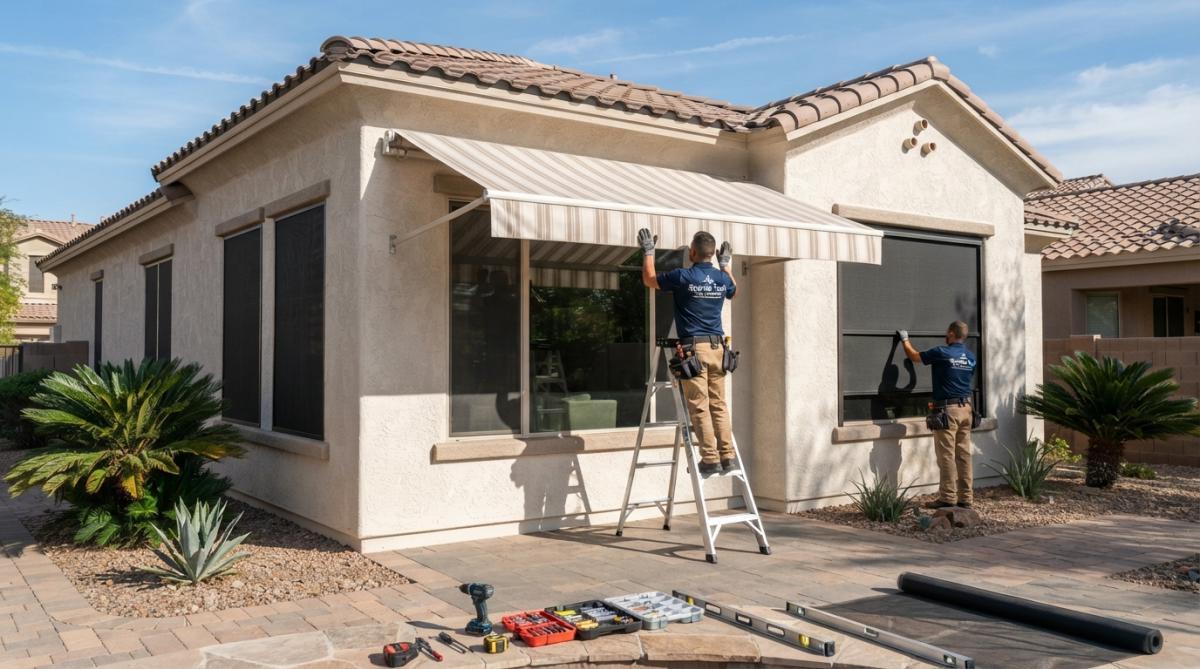
Awnings and Overhangs
Fixed awnings and overhangs provide consistent protection without adjustment. A properly sized overhang on a south-facing window blocks high summer sun while allowing lower winter sun to enter. In Phoenix (latitude 33°N), a south-facing window needs an overhang depth of approximately 1.5 times the window height to block summer sun while allowing winter sun through. A properly designed overhang can reduce summer solar heat gain by 60-75% on south-facing windows.
Modern fabric awnings use UV-resistant materials that remain durable in Arizona’s intense sun for 10-15 years. Motorized awnings retract in winter to allow solar heat gain and extend in summer to provide shade.
Solar Screens and External Shade Structures
Solar screens are mesh panels installed on the exterior of windows that block 50-90% of solar radiation depending on mesh density. Unlike traditional window screens, solar screens use tightly woven fabric that reduces glare and heat while maintaining visibility and airflow.
SPARKLE TECH SUN SCREENS specializes in custom-fit solar screens that match your window dimensions precisely, ensuring maximum coverage and durability in extreme Arizona heat and wind conditions. Professional installation ensures screens are mounted securely, properly sealed to prevent air gaps, and positioned at the correct distance from the window surface.
Pergolas and external shade structures offer architectural flexibility for larger areas like patios and entryways.
External shading blocks solar radiation before it reaches your windows, making it 2-3 times more effective per dollar spent than window replacements alone for reducing solar heat gain.
Step 2: Apply Window Film for Heat Reduction
Window film is a thin polyester layer applied to the interior surface of glass that reduces solar heat gain by reflecting and absorbing infrared radiation. Films range from nearly clear to reflective, with SHGC values from 0.50 for light films to 0.15 for aggressive heat-blocking films.
Window film costs 50-70% less than replacing windows with high-performance glass, making it practical for renters or those with older windows they don’t plan to replace. Quality films last 10-15 years before fading or peeling, while window replacements last 20-30 years.
Reflective films create a mirror-like appearance many homeowners find unattractive. Non-reflective heat-blocking films are more expensive but maintain a clearer appearance. Spectrally selective films block infrared heat while allowing visible light through, reducing solar heat gain by 40-60% while preserving the view.
Low-E Glass and Reflective Coatings
Low-emissivity (low-E) glass has a microscopic metallic coating that reflects infrared radiation while transmitting visible light. The SHGC of low-E glass ranges from 0.20 to 0.50 depending on the coating type.
A single pane of low-E glass reduces solar heat gain by 30-40%. Dual-pane windows with low-E coating achieve 50-70% reduction because the air gap between panes adds insulation value. Low-E windows cost 10-20% more than standard windows but are permanent and don’t degrade like window film. For front-facing windows where appearance matters, spectrally selective coatings are worth the premium.
Step 3: Optimize Window Orientation and Building Siting
Window orientation determines how much sun exposure each wall receives. East-facing and west-facing windows receive intense morning and afternoon sun, creating peak heat gain during the hottest parts of the day. South-facing windows receive lower-angle winter sun (beneficial) and high-angle summer sun (problematic). North-facing windows receive minimal direct solar radiation year-round.
For existing homes, you can optimize which rooms have windows facing problem directions. Bedrooms on the west side benefit from aggressive shading because you want them cool in the evening. Passive solar design principles use building orientation and window placement to minimize cooling loads while maximizing beneficial winter solar heat. A well-designed passive solar home can reduce annual heating and cooling energy by 20-40% compared to a standard home.
Step 4: Use Radiant Barriers and Thermal Mass
Radiant barriers are reflective materials installed in attics and wall cavities to reflect infrared radiation and reduce heat transfer. A radiant barrier in your attic can reduce heat gain by 15-25% because it reflects the sun’s energy back toward the roof surface rather than allowing it to transfer down into living spaces. Air gaps are critical, the barrier must face an air space to be effective.
The cost is moderate, typically $500-$1,500 for an average home, but the payback period is longer than external shading because the reduction in solar heat gain is smaller. Radiant barriers are most cost-effective when combined with other strategies.
Thermal mass refers to materials that absorb and store heat, moderating temperature swings. In a cooling-dominated climate, thermal mass exposed to afternoon sun absorbs heat during the day and releases it into living spaces at night, working against your cooling efforts. Thermal mass in shaded locations can be beneficial: it absorbs cooler nighttime air and releases that coolness during hot days.
Radiant barriers lose effectiveness if dust accumulates on the reflective surface. In Arizona’s dusty climate, plan to inspect and clean attic radiant barriers every 2-3 years to maintain performance. Neglected barriers can lose 30-50% of their effectiveness within five years.
Step 5: Use Vegetation and Landscaping
Strategically placed trees and shrubs reduce solar heat gain through shade and evapotranspiration, the process where plants release water vapor that cools surrounding air. A mature tree can reduce solar heat gain by 20-30% on the side of the home it shades.
Deciduous trees (those that lose leaves in winter) are ideal for south-facing windows because they provide summer shade while allowing winter sun through. Species like Arizona ash, mesquite, and palo verde are adapted to local conditions. Evergreen trees are better for west-facing windows where you want year-round shade.
Evergreen Trees and Strategic Planting
Evergreen trees provide consistent shade year-round, making them ideal for west-facing and east-facing windows. Species like Arizona cypress, desert willow, and Texas privet are drought-tolerant evergreens suited to Phoenix and Scottsdale climates. Planting evergreens on the west side can reduce afternoon solar heat gain by 25-40% once mature.
Trees should be positioned to shade windows and exterior walls during peak heat hours (typically 2 PM to 6 PM in summer). Light-colored mulch, gravel, and pavers reflect more solar radiation than dark materials, reducing the ambient temperature around your home’s exterior.
DIY vs. Professional Installation: Cost-Benefit Analysis
The decision between DIY and professional installation depends on the specific strategy, your skill level, and the long-term value you’re seeking.
| Strategy | DIY Feasibility | Typical DIY Cost | Professional Cost | Best For |
|---|---|---|---|---|
| Interior window coverings | Easy | $50-200 per window | $150-400 per window | Quick, temporary solutions |
| Window film | Moderate | $100-300 per window | $300-600 per window | Older windows you’re keeping |
| Solar screens | Difficult | $150-400 per window | $400-800 per window | Permanent, professional-grade results |
| Awnings/overhangs | Difficult | $500-2,000 total | $2,000-6,000 total | Structural modifications requiring expertise |
| Landscaping | Easy to moderate | $200-1,000 | $1,000-3,000 | Long-term passive cooling |
| Low-E window replacement | Not feasible | N/A | $400-1,200 per window | Comprehensive solution, 20-30 year lifespan |
When DIY Makes Sense
DIY is most appropriate for temporary or easily reversible solutions like interior cellular shades, reflective film on windows, or planting trees and shrubs. Interior window coverings can be installed in 15-30 minutes per window with basic tools, though interior coverings allow heat to build up between the shade and the glass, reducing their effectiveness compared to external shading.
Planting trees and shrubs is an excellent DIY project where you’ll save 50-70% of the cost by doing the digging and planting yourself. The payback period is long, it takes 5-10 years for trees to reach mature size, but the cost is low and the environmental benefits are substantial.
When Professional Installation Delivers Better Value
Professional installation is justified when the project involves permanent structural modifications, requires precision for long-term durability, or carries risk of damage if done incorrectly. Solar screens, awnings, and window replacements all fall into this category.
SPARKLE TECH SUN SCREENS provides custom-fit solar screens with professional installation that guarantees proper fit, secure mounting, and durability in extreme Arizona weather. Window film installation requires precision to avoid bubbles, wrinkles, and misalignment that compromise appearance and performance. Awning and overhang installation involves structural considerations, load calculations, and building code compliance that require professional expertise.
Impact on Cooling Loads and Energy Bills
Reducing solar heat gain directly decreases your cooling load, the amount of heat energy your air conditioning system must remove from your home. By implementing comprehensive solar heat gain reduction strategies, you can reduce cooling energy consumption by 30-50%.
In Arizona, cooling typically runs 6-7 months per year, with peak usage in July and August. A home that reduces cooling load by 40% might see summer electricity bills drop from $300-400 per month to $180-240 per month, a savings of $120-160 monthly during peak season. Over a full year, this translates to $1,500-2,000 in energy savings.
The payback period varies widely. Interior window coverings pay back in weeks. Solar screens typically pay back in 3-5 years. Window replacements might take 7-10 years to pay back through energy savings alone, though improved comfort and durability add value beyond the energy calculation.
HVAC efficiency improves when cooling loads decrease. Your air conditioning system runs fewer hours per day, extending equipment lifespan and reducing maintenance costs. Peak demand charges, increasingly common in Arizona utility rates, create additional incentive to reduce solar heat gain by lowering the demand tier you fall into.
Reducing solar heat gain is achievable through a combination of strategies suited to your home’s orientation, budget, and timeline. The most effective approach combines external shading for immediate impact with longer-term solutions like window upgrades and landscaping. SPARKLE TECH SUN SCREENS delivers custom solar screens with same-week service, professional installation, and a lifetime guarantee on qualifying services, ensuring your heat reduction investment performs reliably through Arizona’s harshest summers. Get your free quote today and discover how much you can save on cooling costs while improving year-round comfort.
Frequently Asked Questions
What is solar heat gain and why is it important to reduce it?
Solar heat gain occurs when infrared radiation from the sun passes through windows and converts to heat inside your home, increasing cooling loads and energy bills. Reducing solar heat gain is important because it decreases the workload on your HVAC system, improves thermal comfort, and lowers cooling costs. In hot climates like Arizona, managing solar radiation through proper glazing, external shading, and window orientation can significantly impact your home's energy efficiency and comfort year-round.
What is the Solar Heat Gain Coefficient (SHGC) and why does it matter?
The Solar Heat Gain Coefficient (SHGC) is a rating between 0 and 1 that measures how much solar radiation passes through a window. A lower SHGC means less heat enters your home, ideal for hot climates. Windows with SHGC ratings of 0.30 or lower are considered high-performance for heat reduction. When selecting windows or films, check the SHGC to ensure they meet your climate needs. In Arizona, choosing low-SHGC glazing or applying window film can reduce your cooling loads significantly.
Do exterior shading devices really work better than interior window treatments?
Yes, exterior shading devices like awnings, overhangs, and solar screens are significantly more effective than interior treatments because they block solar radiation before it enters your home. Interior treatments allow infrared radiation to pass through the glass and convert to heat inside, reducing their effectiveness. External shade structures prevent heat from building up in the first place, making them the preferred choice for reducing solar heat gain and lowering cooling costs. Combined with low-E glass or window film, exterior shading provides the best heat reduction performance.
Can landscaping and vegetation actually reduce solar heat gain in my home?
Yes, strategically placed evergreen trees and vegetation can reduce solar heat gain by blocking direct sunlight and lowering ambient air temperatures around your home. Planting trees on the south and west sides of your home provides shade during peak heating hours while allowing winter sun to reach your windows. Vegetation also improves natural ventilation and reduces the heat island effect. For best results, combine landscaping with other methods like external shading devices, window film, and proper building siting to maximize energy efficiency.
This article was written using GrandRanker