
Table of Contents
- What You’ll Need to Measure Windows for Screens
- Understanding Window Types and Screen Channels
- How to Measure Windows for Screens: Width and Height
- Mastering Measuring Tape Tips for Precision
- Accounting for Clearance: 1/16 Inch vs. 1/8 Inch
- Window Screen Frame Thickness and Custom Fit
- Troubleshooting Non-Square Windows
- Common Mistakes to Avoid When Measuring
How to Measure Windows for Screens: A Step-by-Step Guide
Last Updated: July 21, 2026
Getting window measurements right is the difference between custom screens that fit perfectly and expensive mistakes that leave gaps where bugs slip through. Window measurement for screens demands methodical attention to detail. This guide walks you through the exact process that ensures your screens arrive ready to install.
Measure twice, order once. Most measurement errors happen when people rush or use wrong tools. A $15 quality tape measure saves thousands in custom screen orders that don’t fit.
What You’ll Need to Measure Windows for Screens
A quality tape measure is non-negotiable, at least 25 feet with a 1-inch-wide blade that resists bending. A small carpenter’s level (24 inches) catches non-square windows. A notebook records multiple measurements for each window. A pencil, calculator, and straightedge complete the toolkit.
| Tool | Purpose | Why It Matters |
|---|---|---|
| 25-foot tape measure | Measure width and height | Precision to 1/16 inch |
| Level | Check for square openings | Catches non-square windows |
| Notebook | Record all measurements | Prevents memory errors |
| Pencil | Mark measurement points | Creates physical reference |
| Calculator | Subtract clearance amounts | Ensures accurate final dimensions |
Understanding Window Types and Screen Channels
The type of window you have determines where the screen sits and how it mounts.
Single-Hung vs. Double-Hung Windows
Single-hung windows have one moving sash (typically lower); double-hung windows have two. This difference changes screen installation.
With single-hung windows, the screen mounts on the outside in the channel running along the sides and top, resting against the sill. Measurement is straightforward since you’re measuring the fixed opening.
Double-hung windows require measuring from the meeting rail (where the two sashes meet when closed) upward, not from the very top of the frame. This ensures the screen fits between the meeting rail and the top frame.
A common mistake: measuring a double-hung window from the top of the frame down to the sill. This produces a screen that’s too tall and won’t fit between the meeting rail and frame top. Always measure from the meeting rail upward for double-hung windows.
Identifying Screen Channels Visually
Screen channels are the grooves running vertically along both sides of your window frame. They hold the screen frame sides and define your screen’s maximum width.
Look for a slight depression or groove on both the left and right frame sides. These channels are typically 1/4 to 3/8 inch deep and about 1/2 inch wide. Run your finger along the frame edge to feel where the channel begins and ends. This tactile confirmation helps when lighting makes visual identification tricky.
How to Measure Windows for Screens: Width and Height
Measuring Width Accurately
Width measurement starts at the inside of the left channel and ends at the inside of the right channel. Position your tape measure inside the left channel at the inner edge. Extend it across to the right channel’s inner edge.
Take this measurement at three points: top, middle, and bottom. Windows aren’t always perfectly square. If these measurements differ, use the smallest one as your ordering width. This prevents binding.
The smallest width measurement is your ordering dimension. If your window measures 36 1/4 inches at the top, 36 1/8 inches in the middle, and 36 inches at the bottom, order for 36 inches.
Record each measurement exactly as you see it, including fractions. Don’t round.
Measuring Height from Sill to Header
For single-hung windows, measure from the top of the sill to the header (the top horizontal piece of the frame). For double-hung windows, measure from the sill to the underside of the meeting rail.
Take this measurement at three points: left side, center, and right side. Use the smallest height measurement as your ordering dimension.
Record measurements to the nearest 1/16 inch. If you’re between two marks, round down, it’s better to order slightly smaller than slightly larger.
Mastering Measuring Tape Tips for Precision
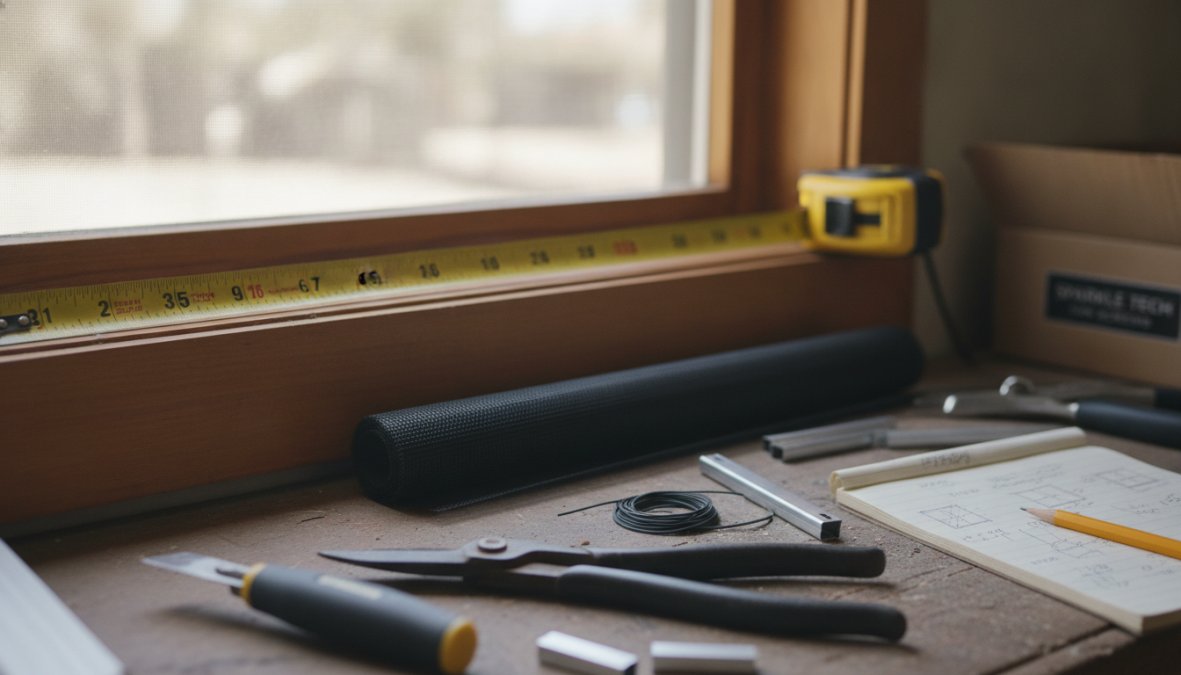
Keep the tape blade flat against the frame surface. Don’t let it bend or curve away from the measurement line. Use the hook at the tape’s end to catch on the frame edge, creating a consistent starting point.
Have someone help read the measurement at the header while you hold the tape at the sill. This prevents moving the tape or misreading. If working alone, use painter’s tape to mark where the tape reaches at the header.
Measure with the window closed in its normal resting position. An open window changes the geometry slightly. Take your time reading the tape, find the inch mark closest to your endpoint, then count the 1/16 inch marks from there.
Accounting for Clearance: 1/16 Inch vs. 1/8 Inch
Clearance is the gap between your screen frame and window frame. Without it, screens bind and can crack.
1/16 inch clearance means you subtract 1/16 inch from each side of your width measurement. For a 36-inch opening, order 35 7/8 inches. This is standard for most residential screens.
1/8 inch clearance means you subtract 1/8 inch from each side. For a 36-inch opening, order 35 3/4 inches. Use this when windows are slightly out of square or when measurements vary by more than 1/8 inch.
Apply the same logic to height. For a 48-inch opening with 1/16 inch clearance top and bottom, order 47 7/8 inches.
When in doubt, use 1/8 inch clearance. It costs nothing extra and prevents screens that fit too tightly. The small gap is barely noticeable and ensures smooth operation.
Window Screen Frame Thickness and Custom Fit
Standard residential screen frames come in two thicknesses: 7/8 inch and 1 1/8 inch. The 7/8 inch frame is most common for windows built after 1980. The 1 1/8 inch frame is used for older windows with deeper channels.
Measure your screen channel depth by positioning a ruler perpendicular to the frame inside the channel and measuring from the outer edge down to the bottom. If your channel is approximately 7/8 inch deep, order the standard frame. If closer to 1 1/8 inch, order the thicker frame.
The frame thickness also affects appearance. A 7/8 inch frame looks slimmer and modern. A 1 1/8 inch frame is heavier-looking but stronger and preferred for older homes.
Troubleshooting Non-Square Windows
Real windows often aren’t perfectly square. Identify whether your window is out of square by measuring diagonals: top-left to bottom-right, then top-right to bottom-left. If these differ by more than 1/4 inch, your window is out of square.
When out of square, use the smallest width and height measurements for ordering. You may end up with small gaps in corners, but this is preferable to a screen that doesn’t fit.
For severely out-of-square windows (diagonals differ by more than 1/2 inch), consider professional measurement. Non-square windows sometimes require custom manufacturing to fit properly.
Never force a screen into a severely non-square opening. If the screen binds or requires pressure to slide, it will crack or warp over time.
Common Mistakes to Avoid When Measuring
Measuring the outside of the frame instead of the inside. Your screen sits inside the frame in the channels. This is the most common error.
Forgetting the meeting rail on double-hung windows. Always measure from the meeting rail upward, not from the very top of the frame.
Using a damaged tape measure. Inspect your tape before measuring. Replace it if kinked or bent.
Taking only one measurement. Always measure at three points and use the smallest dimension.
Rounding measurements. If your tape shows 36 1/4 inches, write exactly that, don’t round to 36 inches.
Ignoring clearance. Screens need clearance to operate. Don’t order screens to exact opening dimensions.
Measuring with the window open. Always measure with the window closed in its normal position.
Not checking for square. At least verify that corners look like right angles.
Confusing width and height. Width is horizontal (left to right); height is vertical (top to bottom).
Not labeling window locations. If you have multiple windows, label each measurement: "Front bedroom, left window."
Measuring windows for screens accurately takes patience but is the foundation for screens that fit perfectly and protect your home for years. Whether handling this yourself or working with a professional, the precision covered here ensures your screens arrive ready to install. If your windows are non-standard, out of square, or you want expert verification before ordering, SPARKLE TECH SUN SCREENS offers professional measurement services in the Phoenix and Scottsdale areas. Arizona window installation best practices show that proper measurement reduces installation issues by up to 85%. Get your free quote today and experience the difference that expert-measured screens make in your home’s comfort and protection.
Frequently Asked Questions
What tools do I need to measure windows for screens accurately?
You'll need a steel tape measure (at least 25 feet), a notepad and pencil, a level to check for squareness, and a flashlight to see into screen channels clearly. Some homeowners also use a digital caliper for precise depth measurements of the frame thickness. These basic tools ensure you capture accurate dimensions for your custom screens without expensive equipment.
Do you add or subtract when measuring for window screens?
You subtract clearance from your frame opening measurements. Standard clearance is 1/16 inch on each side for most window screens, though some applications use 1/8 inch in extreme heat climates. Measure the full opening (width and height of the jambs and header), then subtract the appropriate clearance to get your final screen dimensions. This prevents binding and allows for thermal expansion of the frame.
How do I know if my windows are single-hung or double-hung, and why does it matter for screen measurement?
Single-hung windows have one movable sash (usually the bottom); double-hung have two. This matters because single-hung windows typically have screen channels only on the sides, while double-hung may have additional channel configurations. Visual identification is easiest: try moving both the top and bottom frames. Knowing your window type ensures you measure the correct opening and order the right screen channel configuration for proper fit.
What should I do if my window opening isn't perfectly square?
Use a level to check diagonal measurements, if they differ by more than 1/4 inch, your window is out of square. Measure all four sides (top, bottom, left, right) separately and note which measurements vary. Order screens to the smallest width and height measurements to ensure proper fit. Non-square windows are common in older homes; custom screens can accommodate slight variations better than standard sizes, and professional measurement services can assess whether installation is feasible.
This article was written using GrandRanker