
Table of Contents
- What You’ll Need: Tools for Measuring Windows
- How to Measure Windows for Custom Screens: Width and Height
- Understanding Window Screen Frame Thickness and Hardware
- Types of Window Screens and How to Measure Each
- Window Screen Hardware: What to Look For
- Common Window Screen Measurement Mistakes and How to Avoid Them
- Recording Your Measurements and Next Steps
- Conclusion
Last Updated: July 27, 2026
What You’ll Need: Tools for Measuring Windows
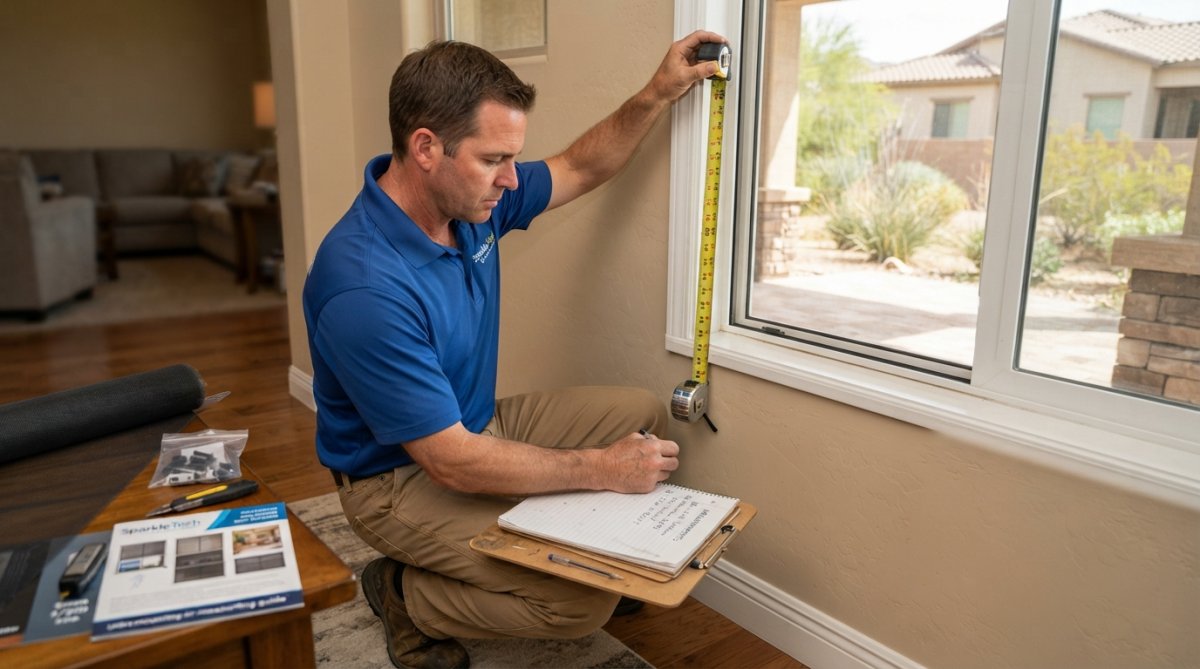
Measuring windows accurately for custom screens requires precision and the right tools. A quality 25-foot tape measure with a wide blade (at least 1 inch) is essential, the wider blade prevents bending and gives you straighter, more reliable readings. You’ll also need a pencil, notepad, and a level to check if your window frame is plumb and square.
Many window screen companies, including professional window measurement guides, provide printable worksheets that walk you through each measurement systematically and prevent common mistakes. A helper is optional but valuable for holding the tape measure steady while you read it. If working alone, painter’s tape can temporarily hold the tape measure in place.
How to Measure Windows for Custom Screens: Width and Height
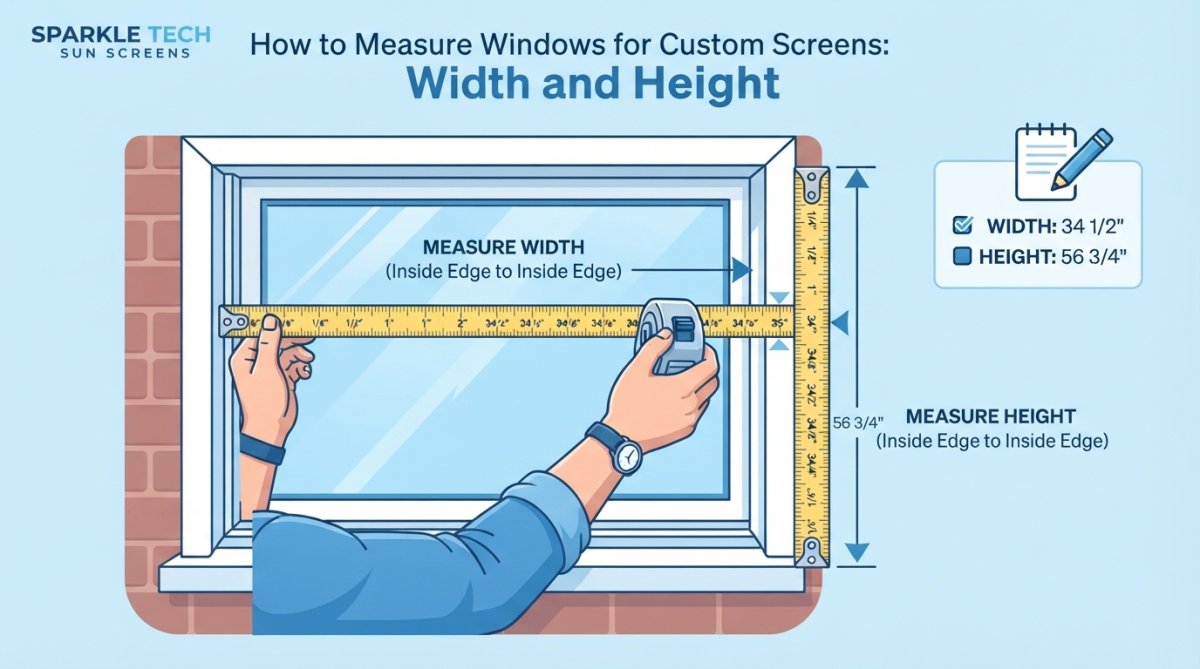
Custom screens fit inside the window frame, so you’ll measure the interior opening where the screen will sit. This is critical because the screen must fit snugly within the frame without gaps that allow insects or debris to enter.
Measuring Screen Frame Width
Width is the left-to-right dimension of your window opening. Place your tape measure horizontally across the top of the opening, pressing it firmly into the corner where the frame meets the glass. Read the measurement where the tape aligns with the inside edge of the right frame.
Now measure the same opening at the middle and bottom. This three-point measurement approach reveals whether your window frame is perfectly square or slightly out of square. Many older windows develop slight irregularities. If your three measurements differ, record all three and note the smallest dimension, this is your actual usable width, since the screen must fit through the tightest point.
If the variance exceeds 1/4 inch, your window may require special attention or a custom-fitted screen. SPARKLE TECH SUN SCREENS specializes in measuring and fitting screens for non-square openings, which is common in Arizona’s older homes and newer construction alike.
When measuring width, keep the tape measure perfectly horizontal and parallel to the ground. Angling it even slightly will give you a false reading.
Measuring Screen Frame Height
Height runs from the top to the bottom of your window opening. Measure from the inside edge of the top frame down to the inside edge of the bottom frame. Position your tape measure vertically along the left side, then repeat on the right side and in the middle. Record all three measurements and note the smallest one.
Height measurements are particularly important because window screens must hang properly. If a screen is cut too tall, it won’t fit into the frame. If it’s too short, it will rattle and allow gaps for insects to enter.
Accounting for Tolerance and Deductions
Tolerance refers to the acceptable variation in screen dimensions. Most custom screen manufacturers allow a tolerance of 1/16 inch to 1/8 inch in either direction.
Deductions are intentional reductions made to screen dimensions to ensure proper fit. If your window frame has a lip or protruding molding on the inside edge, the screen must sit behind this lip, reducing the usable opening. Measure from the inside edge of the actual frame (not the molding) to account for this. Some window styles, particularly older double-hung windows, have deeper frames that require larger deductions.
When you provide measurements to a custom screen provider, clearly note any unusual frame features. SPARKLE TECH SUN SCREENS handles these variations by sending technicians to measure in person, eliminating guesswork and ensuring screens fit perfectly the first time.
Ignoring frame depth and deductions is the most common measurement error. Screens that don’t account for frame lips will either not fit at all or sit proud of the frame, creating visible gaps.
Understanding Window Screen Frame Thickness and Hardware
Window frames vary in depth depending on the window style and era. Modern vinyl-framed windows typically have a frame depth of 1 3/8 inches to 1 3/4 inches. Older wood-framed windows can range from 1 inch to over 2 inches deep. Measure frame thickness by placing your tape measure perpendicular to the window opening, from the outside face of the frame to the inside face.
Identifying Tension Springs and Plunger Pins
Tension springs are small metal coils located along the sides or top of the screen frame that create outward pressure to hold the screen snugly against the window frame. Plunger pins (also called spring pins or friction pins) are spring-loaded pins that fit into grooves or channels in the window frame, providing additional holding force.
Windows with tension springs allow the screen to slide in and out easily for cleaning or seasonal storage. Windows with plunger pins require the screen to be inserted at an angle and then rotated into place, which is common in single-hung windows. Some windows use both systems.
Look closely at your existing screens or window frame channels to determine which system is present. If you see small coiled springs along the sides, you have tension springs. If you see small holes with protruding pins, you have plunger pins. Knowing this before ordering ensures the new screen is built with compatible hardware.
Types of Window Screens and How to Measure Each
Different window styles require different screen configurations.
Single-Hung vs. Double-Hung Windows
A single-hung window has one sash (the movable part) that slides up and down, while the upper sash is fixed. A double-hung window has two sashes that both move independently. This distinction matters significantly for screen placement and measurement.
Single-hung windows typically have screens mounted on the outside of the lower sash. You measure the interior opening of the window frame where the screen will sit. Double-hung windows can accommodate screens on the lower sash (most common), upper sash, or both. If you’re measuring for a double-hung window, clarify which sash will hold the screen.
When measuring double-hung windows, note whether you want the screen to remain in place year-round or be removable for seasonal use. This affects hardware selection and measurement precision.
The most critical distinction between single-hung and double-hung windows is which sash holds the screen. Measure the interior opening where the screen will sit, and communicate the window type clearly when ordering.
Measuring Existing Screens vs. Empty Openings
If you’re replacing an existing screen, remove it and lay it flat on a clean surface. Measure from the outside edge of the frame on one side to the outside edge on the opposite side. However, always verify by measuring the window opening itself using the three-point method. If the old screen and new measurements differ by more than 1/8 inch, the old screen may have sagged or warped, or the window frame may have shifted. Trust your fresh measurements of the opening.
For empty openings where no screen currently exists, your measurements are the foundation for the entire custom screen. Take extra time to ensure accuracy. Measure at three points for both width and height. Use a level to verify the frame is square. If the opening is significantly out of square, more than 1/4 inch variance, mention this when ordering.
Window Screen Hardware: What to Look For
The screen frame itself is typically aluminum or vinyl. Aluminum frames are lightweight, durable, and resist corrosion well in most climates. Arizona’s intense sun makes aluminum an excellent choice for the Phoenix and Scottsdale areas.
The mesh material stretched across the frame comes in several types. Standard fiberglass mesh is the most common and affordable. Solar screens use a tighter weave to reduce heat transmission, critical in Arizona’s climate. Pet-resistant mesh is stronger and withstands scratching. Measuring doesn’t change based on mesh type, but knowing which mesh you need helps you order correctly.
Frame corners are reinforced with corner brackets or welded joints. Quality screens have reinforced corners that prevent the frame from racking (twisting out of square) over time.
Common Window Screen Measurement Mistakes and How to Avoid Them
The most common mistake is measuring only once and in only one location. Measuring at three points reveals variations that single measurements miss. If you measure only at the top and the bottom is narrower, your screen will be too large and won’t fit.
Another frequent error is confusing inside and outside measurements. Custom screens fit inside the window frame. Always measure the interior opening where the screen will actually sit.
Failing to account for frame thickness and deductions is the third major mistake. Decorative molding, recessed frames, or protruding hardware reduce the usable opening. Measure from the inside edge of the actual frame, not the trim.
Troubleshooting Non-Square Windows
A window is out of square when the diagonal measurements differ. Measure diagonally from the top-left corner to the bottom-right corner, then from the top-right to the bottom-left. If these measurements are equal, the window is square. If they differ by more than 1/4 inch, the window is out of square.
Out-of-square windows need screens cut to the smallest usable dimension in each direction. This ensures the screen fits through the tightest point of the opening. For severely out-of-square windows (variance exceeding 1/2 inch), custom-fitted screens with slightly tapered frames can accommodate the variation. SPARKLE TECH SUN SCREENS measures in person and builds screens specifically for your window’s unique dimensions.
Tips for Accuracy: Top, Middle, and Bottom Measurements
Taking measurements at three points is non-negotiable for accuracy. Start at the top of the window opening and measure from the inside edge of the left frame to the inside edge of the right frame. Label this "Top Width." Move to the middle and repeat, labeling "Middle Width." Then measure at the bottom.
For height, measure along the left side at the top, middle, and bottom of the opening. Then repeat along the right side. Record measurements in millimeters if possible, as they’re more precise than fractions of an inch. Write clearly and double-check each number before moving to the next measurement.
Use a consistent reference point for all measurements. Many professionals measure from the inside surface of the frame that faces the room, not the outer edge of the frame material.
Recording Your Measurements and Next Steps
Once you’ve completed all measurements, organize them clearly on your worksheet. Create a simple table with columns for "Location," "Width," and "Height." List all nine measurements and circle or highlight the smallest width and smallest height. These smallest dimensions are what you’ll provide to your screen manufacturer.
Include notes about your window type (single-hung, double-hung, casement, etc.), frame material (aluminum, vinyl, wood), and any special features (decorative trim, recessed frames, existing hardware type). If your window is out of square, note the variance. Take photos of your window from outside and inside, showing the frame, any hardware, and overall condition.
With your measurements and notes in hand, you’re ready to contact a custom screen provider. Many companies, including SPARKLE TECH SUN SCREENS, offer free quote services where you submit your measurements and receive a price estimate. Some providers offer in-person measurement services to verify dimensions before manufacturing, eliminating the risk of ordering screens that don’t fit.
| Measurement Type | Location | Dimension | Notes |
|---|---|---|---|
| Width | Top | [Your measurement] | Record in inches or mm |
| Width | Middle | [Your measurement] | Use smallest width for order |
| Width | Bottom | [Your measurement] | Highlight smallest value |
| Height | Left | [Your measurement] | Record in inches or mm |
| Height | Middle | [Your measurement] | Use smallest height for order |
| Height | Right | [Your measurement] | Highlight smallest value |
(/how-to-measure-windows-for-screens/) Custom Screens: Width and Height]
Conclusion
Measuring windows for custom screens accurately requires attention to detail, the right tools, and a systematic approach. Taking measurements at multiple points, accounting for frame thickness and deductions, and recording your findings clearly sets you up for screens that fit perfectly and perform as intended. According to the American Architectural Manufacturers Association standards, proper measurement tolerance is essential for custom fenestration products to function correctly.
The difference between a DIY measurement and a professional one often comes down to time and experience. If your measurements reveal an out-of-square window, unusual frame depth, or other complications, professional measurement services eliminate guesswork. SPARKLE TECH SUN SCREENS provides free in-person measurements throughout the Phoenix and Scottsdale areas, ensuring your custom screens are built to fit your specific windows perfectly. With same-week service and a lifetime guarantee on qualifying screen services, you’ll have durable, weather-resistant screens protecting your home from Arizona’s intense sun, heat, and dust while improving airflow and curb appeal. Get your free quote today and experience the difference that precision measurement and professional craftsmanship deliver.
Frequently Asked Questions
What is the best way to measure for custom window screens?
The best approach is to measure the inside edge of your window opening at three points: top, middle, and bottom. Use a tape measure and record the shortest measurement for width and height. Account for 1/16 inch to 1/8 inch tolerance and any deductions needed for screen hardware like tension springs. Always measure twice and record your findings on a printable worksheet to avoid errors when ordering custom screens.
Do you measure window screens from the inside or outside?
Measure from the inside edge of the window frame opening, not the outside. This ensures your custom screen fits properly within the frame. If you're measuring an existing screen, measure the screen frame itself. For empty openings without a current screen, always measure the inside dimensions of the window opening where the new screen will sit and be secured by the frame thickness and hardware.
How much do you subtract for a window screen measurement?
Subtract 1/16 inch to 1/8 inch total from your measurements to account for tolerance and proper fit. This allows your custom screen to slide smoothly into the frame without binding. The exact deduction depends on your window's frame thickness and the type of screen hardware (tension springs, plunger pins, or channels). Always consult your screen supplier's specific deduction guidelines for accuracy.
How do I know if my windows are single-hung or double-hung for screen measurement?
Single-hung windows have one fixed pane and one movable pane; double-hung windows have two movable panes. For single-hung windows, measure the opening of the movable section. For double-hung windows, you may need separate screens for upper and lower sections, or one screen for the lower opening. Visual identification of which sashes move helps determine your screen type and ensures you measure the correct opening dimensions for your custom screens.
This article was written using GrandRanker