
Table of Contents
- How Solar Screens Block UV Rays
- Understanding UVA and UVB Protection Explained
- Broad-Spectrum Sunscreen Benefits for Your Home
- Mineral vs Chemical Sunscreen: Screen Material Comparison
- What Percentage of UV Rays Do Sun Screens Block?
- How to Choose Effective Sunscreen Mesh for Arizona Homes
- Health and Home Protection: UV Rays and Interior Damage
- Energy Efficiency and Thermal Heat Gain Reduction
Do Sun Screens Block UV Rays? Complete Guide
Last Updated: August 2, 2026
When homeowners in Phoenix and Scottsdale ask whether sun screens block UV rays, the answer is straightforward: yes, they do, but effectiveness depends on mesh type, density, and how the material interacts with ultraviolet radiation. At SPARKLE TECH SUN SCREENS, we’ve spent years helping Arizona residents understand exactly how much solar protection they’re getting and which screen types deliver the best results for their specific climate and home protection needs. This guide breaks down the science behind UV filtration, explains available materials and technologies, and shows you how to choose effective sunscreen mesh that performs in Arizona’s intense heat and light.
Understanding which screens block UV rays matters because unfiltered UV exposure damages furniture, degrades flooring, and increases cooling costs. The right screens protect your home’s interior while reducing energy consumption.
How Solar Screens Block UV Rays
Solar screens work through two primary mechanisms: physical barriers and UV absorption. The mesh acts as a physical barrier that interrupts ultraviolet radiation before it reaches your windows and interior spaces. Unlike standard insect screens designed mainly for airflow, solar screens use tightly woven synthetic fibers specifically engineered to absorb and reflect a significant portion of the sun’s energy.
Most solar screens are made from PVC-coated polyester or fiberglass mesh, both with inherent UV-absorbing properties. When UV rays strike these materials, some energy is absorbed and converted to heat (which dissipates away from your home), while some is reflected back outside. This dual action makes these screens highly effective at reducing solar heat gain.
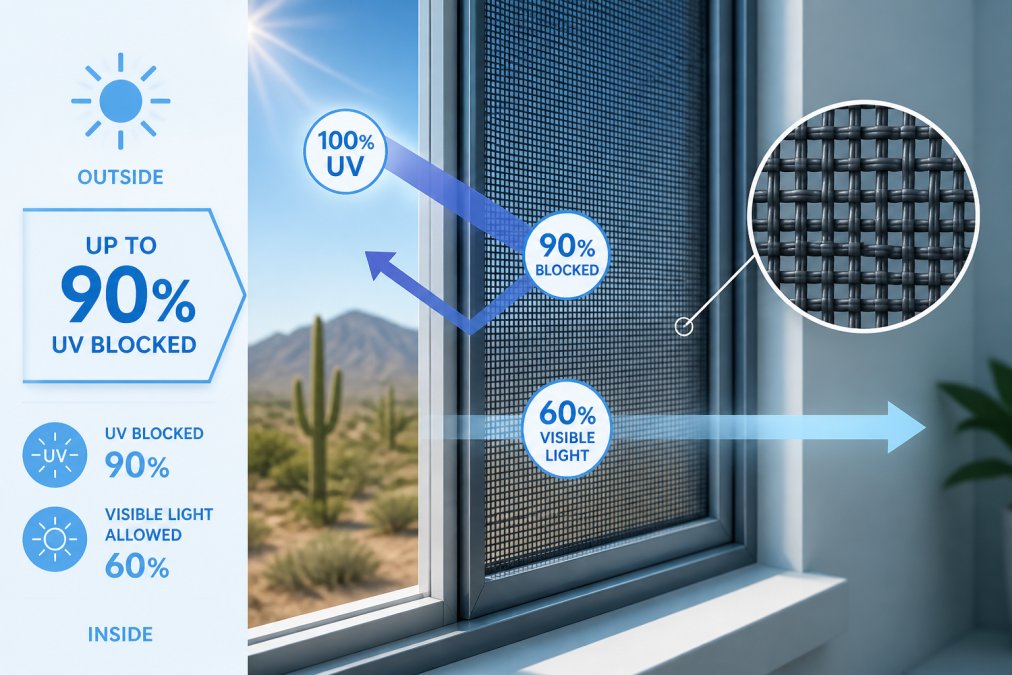
The openness factor, the percentage of open space in the mesh compared to solid material, directly affects UV blocking. A screen with 5% openness factor blocks far more UV rays than one with 14% openness factor, though it also reduces visible light transmission slightly more. This trade-off between UV protection and daylight is a key decision when selecting screens.
Solar screens reduce radiant energy, meaning your air conditioning system works less hard. Most Arizona homeowners see measurable [cooling cost reductions](/do-sun-screens-lower-energy-bills/) within the first month of installation, especially on south and west-facing windows where solar heat gain is most intense.
Understanding UVA and UVB Protection Explained
Ultraviolet radiation exists in two primary forms: UVA rays (320-400 nanometers) penetrate deeply and cause long-term skin damage and material photodegradation. UVB rays (280-320 nanometers) are more intense but don’t penetrate as deeply; they’re the primary cause of sunburn and surface-level material fading.
Quality solar mesh blocks both UVA and UVB simultaneously. A well-designed solar screen typically blocks 70-90% of total ultraviolet radiation, providing substantial protection for both your skin and your home’s interior. The mesh density and material composition determine the blocking percentage for each wavelength.
How Mesh Density Affects UV Filtration
Mesh density refers to the number of fibers per inch in the screen material. Higher density means more UV absorption and reflection. The relationship between density and UV blocking follows a curve where the first increase in density provides the most dramatic improvement in UV protection, with each subsequent increase providing diminishing returns.
Standard insect screens have very low mesh density optimized for visibility and airflow. They block only 20-30% of UV rays and provide minimal thermal protection. This is a critical distinction: not all screens are solar screens, and a basic screen won’t deliver the UV protection or energy efficiency benefits you’re seeking.
Broad-Spectrum Sunscreen Benefits for Your Home
When solar screens block UV rays across the full spectrum, your home receives multiple layers of protection. Broad-spectrum protection means consistent blocking across all wavelengths of ultraviolet radiation, not just selective filtering.
The benefits accumulate quickly. Furniture exposed to unfiltered sunlight fades within 6-12 months; with effective solar screens, that same fading takes 3-5 years. Hardwood floors resist photodegradation far more effectively when UV rays are filtered before entering the room. Broad-spectrum UV blocking also improves interior climate control, when less ultraviolet and infrared radiation enters through windows, your HVAC system maintains consistent temperatures more easily. Homeowners report that rooms with solar screens stay 5-10 degrees cooler than adjacent rooms without them.
Visible Light Transmission and Glare Reduction
Visible light transmission (VLT) is the percentage of visible light that passes through the screen. A screen that blocks 90% of UV rays might allow 8-10% visible light transmission, meaning your room will be noticeably darker. This darkness creates glare reduction, the screen diffuses incoming light and reduces harsh reflections on screens and interior surfaces.
A 5% openness factor screen might have 5-8% VLT, while a 14% openness factor screen could have 12-15% VLT. For Arizona homes, the 10% range is most popular because it balances strong UV blocking with enough visible light to maintain natural daylight indoors.
Mineral vs Chemical Sunscreen: Screen Material Comparison
Just as mineral sunscreen uses physical blockers while chemical sunscreen uses absorption mechanisms, solar screens combine both physical and chemical approaches to UV protection. PVC-coated polyester screens function like physical blockers, the dense weave creates a barrier and the PVC coating reflects radiation. Fiberglass mesh screens function more like absorbers, the material itself absorbs UV energy and converts it to heat. Both approaches block UV rays effectively; the choice comes down to durability, cost, and specific performance characteristics.
PVC-Coated Polyester and Fiberglass Mesh Options
PVC-coated polyester is the most common solar screen material in Arizona. It’s durable, resists degradation from intense sun exposure, and maintains its properties for 10-15 years. These screens typically cost less upfront and are easier to install in custom sizes.
Fiberglass mesh offers superior durability in extreme climates. The fiberglass fibers don’t degrade as quickly under constant UV exposure, maintaining UV blocking effectiveness for 15-20 years. Fiberglass is also more resistant to tearing. The trade-off is higher cost and slightly more difficulty customizing for unusual window sizes.
For most Arizona homeowners, PVC-coated polyester delivers excellent value. If you live in an area with extreme sun exposure or have pets that frequently push against screens, fiberglass is worth the additional cost.
Never assume all “solar screens” are created equal. Some budget screens use thin PVC coatings that degrade within 3-5 years, leaving you with a screen that no longer blocks UV rays effectively. At SPARKLE TECH SUN SCREENS, we use materials that maintain their UV blocking properties throughout their lifespan, backed by our lifetime guarantee on qualifying services.
What Percentage of UV Rays Do Sun Screens Block?
A high-quality solar screen with 5% openness factor typically blocks 85-95% of ultraviolet radiation. A screen with 10% openness factor blocks 75-85%. A screen with 14% openness factor blocks 65-75%. These percentages are measured using standardized testing methods that expose the material to the full spectrum of UV radiation.
The percentage that matters most depends on your goals. If you’re primarily concerned with reducing solar heat gain and cooling costs, even 65-70% UV blocking delivers noticeable results. If your focus is protecting valuable furniture from fading, you’ll want 85% or higher. For skin protection during patio use, 75% minimum is recommended.
Openness Factor and Its Role in UV Protection
Openness factor represents the ratio of open space to total screen area. A 5% openness factor screen has 5% open space and 95% solid material. This single specification drives most performance characteristics: UV blocking percentage, glare reduction, visible light transmission, and solar heat gain coefficient.
Lower openness factors (5-8%) deliver maximum UV protection and thermal control but reduce visibility and airflow. These screens are ideal for south and west-facing windows. Higher openness factors (12-14%) maintain better visibility and ventilation but provide less UV blocking. These work well for north-facing windows or areas where you want strong natural light.
How to Choose Effective Sunscreen Mesh for Arizona Homes
Selecting the right solar screen requires balancing UV protection, thermal control, visibility, and cost. Start by identifying which windows receive the most intense sun exposure. In Arizona, south and west-facing windows typically receive 2-3 times more solar radiation than north-facing windows.
For high-exposure windows, choose a 5-8% openness factor screen. For moderate-exposure windows (east-facing), a 10% openness factor offers a good balance. For low-exposure windows (north-facing), you might use a 14% openness factor if maintaining visibility is important.
Next, decide between PVC-coated polyester and fiberglass. If your screens will be in place for 10+ years and you have the budget, fiberglass is the more durable choice. If you’re prioritizing cost, PVC-coated polyester is perfectly adequate. Both materials block UV rays effectively.
Work with a professional installer who can measure your windows accurately and explain how each option will perform in your specific situation. Custom-fit screens are essential, screens that don’t fit properly allow UV radiation to leak around the edges.
Comparing Standard Insect Screens vs. Solar Screens
Standard insect screens are designed primarily for pest control and ventilation. They use open mesh construction (typically 18-20% openness factor or higher) that prioritizes airflow and visibility. A standard insect screen blocks only 20-30% of UV rays and provides minimal solar heat gain reduction.
Solar screens use dense mesh construction specifically engineered to block UV radiation and reduce thermal heat gain. They block 65-95% of UV rays depending on openness factor. Many Arizona homeowners use both: standard screens on north-facing windows for ventilation, solar screens on south and west-facing windows for thermal control.
Glass Type Interaction and Window Performance
Standard clear glass blocks about 25% of UV rays naturally. Low-E glass blocks 40-60% of UV rays. High-performance coated glass can block 80% or more. When you add a solar screen to any of these window types, the UV blocking percentages are cumulative. A solar screen that blocks 90% of UV rays, combined with glass that already blocks 25%, results in most UV radiation being stopped before entering your home.
If you have older clear glass windows, adding a solar screen makes an enormous difference. If you already have high-performance coated glass, the solar screen’s benefit is more modest, though still significant for thermal control and glare reduction.
Health and Home Protection: UV Rays and Interior Damage
Ultraviolet radiation damages both human skin and home materials through similar mechanisms. UV energy breaks chemical bonds in organic compounds, causing structural degradation. For skin, this manifests as sunburn, aging, and increased skin cancer risk. For home materials, this appears as fading, brittleness, and color loss.
Prolonged exposure to unfiltered UV rays increases melanoma risk and accelerates skin aging. Solar screens don’t eliminate UV exposure entirely, but they reduce it by 65-95%, which meaningfully lowers your cumulative risk.
Protecting Furniture, Flooring, and Skin from UV Exposure
Furniture fading is one of the most visible signs of UV damage in homes. A room with unfiltered south-facing windows will show noticeable fading within 6-12 months. The same room with an effective solar screen will maintain colors for 3-5 years before comparable fading occurs.
Hardwood floors are particularly vulnerable to UV exposure, which causes the wood to bleach and lose its original color. Installing solar screens on windows that shine directly on hardwood floors can extend the life of your flooring by years.
For skin protection, the benefit of solar screens is cumulative but not complete. A screen that blocks 85% of UV rays reduces your exposure by 85%, but you still receive 15% of the UV radiation. For extended outdoor time, you should still use additional sun protection, but solar screens reduce your baseline exposure significantly.
The cumulative effect of UV protection matters more than the percentage at any single moment. A solar screen that blocks 80% of UV rays, used consistently over months and years, prevents far more damage than sporadic sunscreen application. This is why [professional installation is worthwhile](/benefits-of-professional-screen-installation/), a properly installed screen delivers consistent, long-term protection.
Energy Efficiency and Thermal Heat Gain Reduction
Solar screens reduce energy consumption by blocking infrared radiation, the component of sunlight that generates heat. When less heat enters your home through windows, your air conditioning system runs less frequently and for shorter durations, resulting in measurable savings on cooling costs.
The solar heat gain coefficient (SHGC) measures how much solar radiation passes through a window and enters your home as heat. Standard clear glass has an SHGC of about 0.80. A solar screen with 5% openness factor can reduce this to 0.15-0.25, meaning only 15-25% of solar radiation becomes indoor heat. This dramatic reduction translates to 20-30% lower cooling costs for south and west-facing windows.
An average Arizona home with solar screens on all south and west-facing windows can reduce annual cooling costs by 15-25%, depending on window orientation, climate zone, and screen specifications. Over a 10-year screen lifespan, this amounts to substantial savings that often exceed the installation cost. Reduced air conditioning usage also means lower electricity consumption and reduced carbon emissions.
Protecting your Arizona home from intense UV radiation and solar heat gain requires understanding how different screen types perform and choosing materials matched to your specific windows and climate. Quality solar screens block 65-95% of ultraviolet radiation, depending on mesh density and material composition. This protection extends to your furniture, flooring, skin, and your cooling costs.
SPARKLE TECH SUN SCREENS provides custom-fit solar screens engineered specifically for Arizona’s harsh climate. Our PVC-coated polyester and fiberglass mesh options are designed to maintain their UV blocking effectiveness, backed by our lifetime guarantee on qualifying services. We handle precise measurements, professional installation, and ongoing support, ensuring your screens deliver consistent protection from day one. Get Your Free Quote and discover how solar screens can transform your home’s comfort and durability.
Frequently Asked Questions
What percentage of UV rays do sun screens actually block?
Solar screens typically block 65-90% of ultraviolet radiation, depending on the mesh density and material composition. Higher openness factors (larger mesh openings) allow more visible light through but reduce UV protection slightly. For maximum UV protection in Arizona's intense sun, screens with lower openness factors (around 5-10%) block the most ultraviolet radiation while still maintaining reasonable visibility and airflow through your home.
How do mineral vs chemical sunscreen mesh materials differ in UV blocking?
Mineral-based mesh screens (like those using reflective coatings) work by reflecting UV rays away from your home's interior, while chemical-based mesh materials absorb ultraviolet radiation. PVC-coated polyester and fiberglass mesh are common chemical options that absorb UV energy. Both approaches effectively reduce UV exposure, but reflective mineral coatings tend to reduce heat gain more significantly, making them better for energy efficiency in hot climates like Phoenix and Scottsdale.
Do standard insect screens block UV rays as well as solar screens?
Standard insect screens block only 5-15% of UV rays because they're designed primarily for airflow and pest protection, not solar protection. Solar screens are engineered with tighter mesh weaves and special materials to block 65-90% of ultraviolet radiation while still allowing light and air circulation. If UV protection and heat reduction matter to you, solar screens provide significantly better performance than standard screens.
How does glass type affect UV protection from sun screens?
Most standard residential glass blocks about 75% of UVB rays but allows most UVA rays through. Adding a solar screen to any window type increases total UV protection substantially. Low-E or tinted glass can enhance UV blocking further, but solar screens work effectively with all glass types. The combination of your window glass and solar screen determines your total protection level against both UVA and UVB radiation.
This article was written using GrandRanker