

Too much sunlight pouring through your windows can turn a comfortable living space into an unbearable greenhouse, fade your furniture, and send your energy bills skyrocketing. Fortunately, homeowners today have more options than ever when it comes to controlling solar heat and glare. But with so many products on the market, choosing the right solution can feel overwhelming.
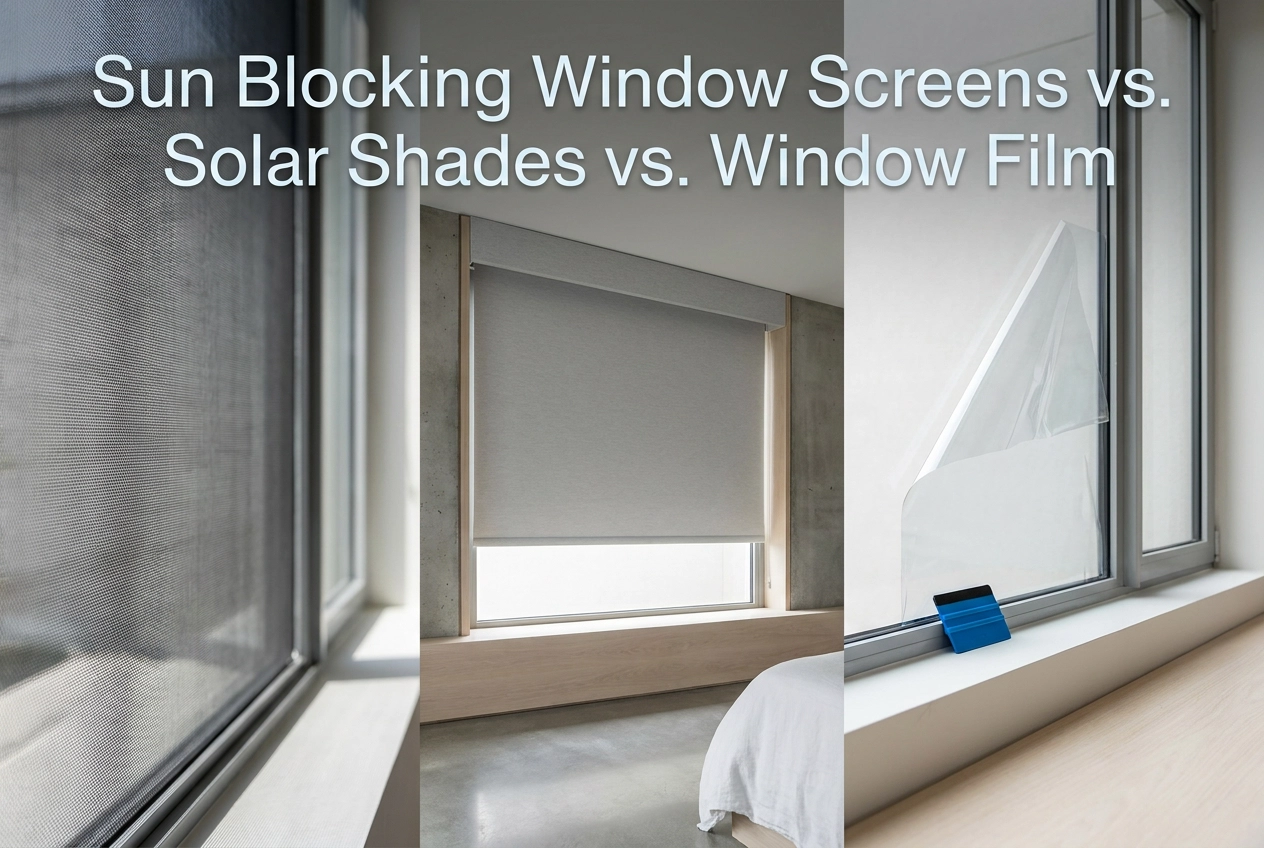
In this post, we’re breaking down three of the most popular window treatment options: sun blocking window screens, solar shades, and window film. Each of these solutions takes a different approach to managing sunlight, and each comes with its own set of strengths and trade-offs. Understanding those differences is the key to making a smart investment for your home.
Whether you’re trying to reduce glare on your television, lower your cooling costs, or protect your interior from UV damage, this comparison will give you a clear, practical look at how these three options stack up. By the end, you’ll know exactly which solution fits your needs, your budget, and your home’s specific conditions.
What Are Sun Blocking Window Screens?
Sun blocking window screens, more precisely called exterior solar screens, are mesh panels mounted on the outside of your window frames rather than behind the glass. This placement is the defining advantage: by intercepting solar heat and UV radiation before it ever contacts the glass surface, exterior screens outperform every interior alternative. The U.S. Department of Energy recognizes exterior shading as the most effective method of reducing solar heat gain, and the thermal data supports that position. Exterior solar screens achieve shading coefficients between 0.14 and 0.33, compared to 0.50 to 0.70 for interior screen products, meaning significantly less heat transfers into your home before your cooling system ever has to respond.
The single most important specification to understand when comparing screen options is the openness factor, which describes the percentage of the screen surface that is open space rather than mesh material. A screen with 10% openness blocks roughly 90% of incoming solar radiation while still permitting natural light to enter and allowing reasonable outward visibility. Custom solar screens for windows are available across an openness range from as low as 1% to as high as 25%, giving homeowners meaningful control over the balance between privacy, light transmission, and heat rejection.
Material selection is the next key variable. The two most common options are PVC-coated polyester and PVC-coated fiberglass. Polyester-based screens use an extrusion process that produces thicker, more durable yarns suited to high-exposure installations. Fiberglass screens use a thinner drip-coat process and remain widely used due to their flexibility and cost profile. Both material types benefit from PVC coatings that improve UV resistance and expand available color options. Solar screens for windows are offered in both materials across multiple weave densities to match varied performance and aesthetic goals.
Beyond sun control, exterior solar screens serve a genuine dual purpose: they block insects as effectively as a standard bug screen, eliminating the need for two separate screen products on the same window. Color choice also carries functional weight. Darker mesh colors, particularly charcoal and black, provide superior glare reduction and maximize heat rejection. Lighter colors transmit more visible light but sacrifice some solar performance, making them better suited to north-facing windows or lower-sun exposures.
Option 1: Exterior Solar Screens
Exterior solar screens represent the highest-performing option in this comparison, and the reason comes down to physics. Because the mesh sits outside the glass, it intercepts solar radiation before it can be absorbed by the window itself. Interior products, including roller shades and blinds, allow heat to pass through the glass first, trapping it in the air gap between the shade and the pane before it radiates inward. Exterior placement breaks that thermal chain at its source, which is why shading coefficients for exterior solar screens range from 0.14 to 0.33, compared to 0.50 to 0.70 for the same type of screen installed indoors. That difference in numbers translates directly to a measurably cooler interior and a reduced cooling load on your HVAC system.
Performance also varies by the mesh itself. According to Phifer’s solar screen guide, solar screen fabrics can block anywhere from 65% to 97% of heat depending on the openness factor and color selected. High-performance fabrics with tighter weaves and darker colors consistently deliver solar heat rejection at the upper end of that range, with some products blocking 90% or more of incoming radiation. For homeowners in sun-heavy climates, this reduction in solar heat gain has a measurable impact on cooling costs across a full summer season.
A frequently overlooked advantage is the dual functionality. One exterior solar screen replaces both the insect screen and the interior shade on the same window opening. Residents in high-solar markets have noted this consolidation as a practical win, with community discussions in Sun Belt areas treating exterior screens as a near-standard home feature rather than an upgrade.
On the cost side, exterior screens offer a long-term efficiency advantage through rescreening. When the mesh fabric degrades after years of UV exposure, only the mesh needs replacing; the frame stays in place. A real-world example from an Arizona homeowner showed frames still serviceable after 11 years, with only the mesh requiring attention.
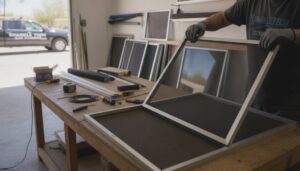
Sparkletech handles both new solar screen installation and rescreening on existing frames, with same-week scheduling available. That turnaround is a practical edge that most interior shade retailers and online-order options cannot offer, particularly when you need screens in place before the next heat wave arrives.
Option 2: Interior Solar Shades
Interior solar shades are roller-style window treatments installed inside the window frame, designed to filter UV rays and reduce glare while still admitting diffused natural light. They are widely available, easy to install, and represent a genuinely popular solution for sun management. However, their placement creates a meaningful thermal limitation. Because the shade sits on the interior side of the glass, solar heat is first absorbed by the glazing and then radiates into the room before the shade can intercept it. Exterior solar screens, by contrast, block that heat before it ever contacts the glass. For homeowners prioritizing energy efficiency as a primary goal, this distinction matters in real, measurable ways on cooling costs.
Consumer awareness of interior solar shades is unquestionably strong heading into 2026. Major national retailers have named solar shades as a distinct trend category in their current buying guides, and 2026 window treatment trend coverage prominently features solar shades alongside roller and cellular options. That mainstream recognition reflects genuine product demand, but it is worth noting that this retail trend coverage addresses only interior applications. None of these retailers extend their offerings to exterior solar screen installation, rescreening, or repair.
Interior solar shades do excel in specific scenarios. They are the practical choice for renters who cannot modify a building’s exterior, for condo owners subject to HOA restrictions on exterior screen installation, and for windows where structural or architectural factors make outside mounting impractical. If you live in a historic building or a high-rise with limited exterior access, an interior shade may simply be your only viable option.
The smart home integration angle is also worth acknowledging. Motorized and smartphone-controlled solar shades are increasingly treated as a standard offering rather than a luxury upgrade, with the smart solar tracking window shades market projected to reach USD 2.76 billion by 2030 at a CAGR of 13.7%. Compatibility with Google Home and Amazon Alexa is now a baseline expectation across multiple 2026 trend reports, making these products genuinely appealing for tech-forward homeowners.
The critical functional gap, however, is insect protection. Interior solar shades provide none. Homeowners who need both sun control and bug protection must install a separate insect screen, adding cost and complexity that a single exterior solar screen solution eliminates entirely.
Option 3: Solar Control Window Film
Solar control window film is a thin, adhesive-backed layer applied directly to the interior glass surface that works by reflecting or absorbing UV and infrared radiation before it fully transmits into your living space. It is a low-profile solution with no visible external hardware, making it appealing in situations where exterior modifications are restricted, such as HOA-governed communities or rental properties. The film operates using measurable performance metrics including Total Solar Energy Rejected (TSER), Solar Heat Gain Coefficient (SHGC), and Visible Light Transmission (VLT), giving buyers a framework for comparing products across a wide range of quality tiers, from basic dyed films to higher-performance ceramic and metalized variants.
Where Film Falls Short Compared to Exterior Solutions
The most significant limitation of interior window film is thermodynamic. Because the film sits on the inside of the glass, solar energy must first pass through and heat the outer glass surface before the film can act on the remaining transmitted radiation. Exterior solar screens intercept that energy before it ever contacts the glass, which is a structurally more efficient position in the heat-transfer chain. Film also provides no insect barrier and no physical mesh, meaning it addresses only one of the two core functions that exterior screens deliver simultaneously. For homeowners dealing with both sun and bug intrusion, film alone is an incomplete solution.
Durability Risks and Long-Term Costs
Film performance varies considerably by product quality. Lower-grade options are prone to bubbling, peeling, and color shift within three to five years, which can make long-term ownership more expensive than the initial installation cost suggests. Removal is another concern; permanently bonded film can be labor-intensive to take off and may damage low-e coatings or older pane surfaces in the process. According to sun control window film guides, the market now spans anti-glare, UV-protection, transitional, and dynamic adaptive categories, reflecting genuine product diversity but also significant potential for buyer confusion.
The solar control window films market is actively growing and represents a legitimate option some homeowners will encounter during their research. However, it is best positioned as a complement to exterior screening in specific contexts, such as fixed windows in restricted-modification buildings, rather than a primary substitute for sun blocking window screens.
Side-by-Side Comparison: Screens vs. Shades vs. Film
When choosing between sun blocking window screens, interior shades, and window film, the single most important variable is where each solution intercepts heat. Exterior solar screens stop solar radiation before it ever contacts the glass, keeping the window surface cool and preventing heat transfer into your living space entirely. Interior shades, by contrast, allow sunlight to pass through the glass first, trapping radiant heat in the gap between the fabric and the pane, where it then radiates inward. Window film operates on heat that has already reached the glass surface, limiting its ability to prevent the glass itself from heating up. This fundamental difference in interception point is why solar screens vs window film comparisons consistently favor exterior-mounted solutions in high-sun climates.
UV blocking performance is strong across all three options, but not equally so. Exterior solar screens with a 10% openness factor reject 90% or more of solar radiation directly at the source, before any energy enters the thermal envelope of your home. Interior shades and window film reduce UV transmission as well, but since both operate after sunlight has already reached or penetrated the glass, their net heat-rejection efficiency is structurally lower.
On the question of insect protection, only exterior solar screens serve a dual purpose. As solar screen and insect screen comparisons confirm, interior shades and window film provide zero pest control benefit, meaning homeowners who rely on them still need a separate screen solution for ventilated windows.
Repairability also favors exterior screens meaningfully. A damaged screen can be rescreened frame by frame at a fraction of replacement cost. Degraded interior shade fabric requires full unit replacement, and window film removal involves adhesive residue and typically requires professional reapplication.
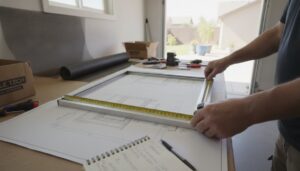
From an installation standpoint, exterior screens require professional measurement and custom mounting, but the long-term value through rescreening offsets that initial investment. Interior shades offer DIY flexibility, though motorized versions require professional integration. Window film is technically DIY-friendly but highly error-prone on large panes, and mistakes require professional correction.
What the Energy Savings Data Actually Shows
Market data tells a compelling story about where consumer confidence is actually placed. The residential solar shades sub-segment is forecast to grow at a CAGR of 14.9% from 2026 to 2033, making it one of the fastest-growing categories within the entire window treatments industry. That growth rate nearly doubles the broader window coverings market’s projected CAGR of 7.7%, which itself represents expansion from USD 18.9 billion in 2026 to USD 36.9 billion by 2035. When a sub-segment outpaces its parent market by that margin, it reflects more than trend interest; it reflects verified, repeated purchase decisions by homeowners who have seen measurable results.
The physics behind those results are straightforward. Exterior screens intercept solar radiation before it contacts the glass surface, preventing the heat conversion that occurs once sunlight passes through. According to the 2026 guide to energy-efficient window treatments, high-quality exterior solar screens can reduce solar heat gain by up to 77% and lower indoor temperatures by as much as 15°F during peak summer conditions. ENERGY STAR data reinforces the scale of the opportunity, noting that windows account for approximately 45% of home heat gain or loss despite representing only around 8% of a home’s exterior surface area. Targeting that leverage point with an exterior screen produces a direct, measurable reduction in cooling load and air conditioning energy consumption during the months when utility bills are highest.
Energy efficiency is now ranked as the primary purchase driver for solar screens in 2026, as sustained increases in utility rates make passive cooling solutions financially attractive rather than simply environmentally preferable. Homeowners evaluating window treatment statistics consistently cite HVAC cost reduction as the leading motivation, ahead of aesthetics or UV protection. Exterior solar screens address that motivation at the source, reducing the thermal burden on cooling systems before it enters the home rather than compensating for heat that has already accumulated indoors. For homeowners prepared to invest now, the combination of immediate energy savings and growing market valuation of energy-efficient properties positions exterior solar screens as one of the higher-return upgrades available in today’s residential improvement landscape.
When to Repair or Rescreen Instead of Replace
When the mesh fabric on an exterior solar screen has faded, torn, or lost its weave tension, rescreening the existing frame is almost always the more cost-effective path forward. Solar-grade mesh replacement typically runs $40 to $60 per screen, compared to $120 to $400 for a full solar screen replacement including a new frame. Because solar screen fabric is denser and more specialized than standard fiberglass mesh, the savings from preserving a structurally sound frame are proportionally larger than with conventional window screens.
Diagnosing Whether Rescreening Is Enough
The key diagnostic question is whether the aluminum frame itself is still structurally viable. Rescreening is the right call when you observe any of the following: visible mesh discoloration or color shift caused by UV degradation, small holes or tears in the fabric, sagging or looseness in the screen weave even without obvious damage, or a spline that has come loose in sections. According to a 2026 window screen repair and replacement cost guide, rescreening works best when “the aluminum frame is straight, the corners are tight, and the channel is not bent or corroded.” Approximately 90% of screen damage falls into the mesh-damaged, frame-intact category, making rescreening the dominant repair path by volume.
Full frame replacement becomes necessary when the frame is bent beyond a minor correction, corners have cracked or separated, or the spline channel is crushed. Re-tensioning new mesh onto a warped frame produces poor seating and functional gaps, regardless of mesh quality. Per the Window Screen Repair vs Replacement Cost Guide 2026, if repair costs exceed 50% of full replacement cost, replacement becomes the smarter investment.
Sparkletech handles both rescreening and frame repair services, so homeowners can restore full solar performance without the unnecessary cost or material waste of replacing functional components. Regular screen cleaning further extends mesh service life by preventing dirt, pollen, and oxidation buildup, all of which accelerate UV fabric degradation over time, particularly on west-facing or high-sun exposures.
Why Same-Week Installation Changes the Equation
Custom interior solar shades ordered through big-box window treatment retailers typically carry production and delivery lead times ranging from two to six weeks. That window represents real cost: rooms that overheat, glare that disrupts daily work, and energy bills that climb while the order sits in a fabrication queue. For homeowners who discover their west-facing living room is unlivable in July, waiting a month for a solution is not an acceptable answer.
The structural reason exterior solar screen specialists can offer same-week service is worth understanding clearly. Interior custom shades require factory cutting, hemming, and hardware assembly to precise specifications before the product ships. Exterior solar screens are field-fabricated: the mesh is cut on-site to fit existing frames, which means no factory queue and no shipping delay. This is not a promotional distinction; it is a production-method distinction. The work simply does not require a manufacturing pipeline.
That speed advantage becomes particularly valuable in three scenarios: the approach of peak summer heat when comfort is at stake, a pre-listing home showing where untreated windows read as a deficiency to buyers, and a short-term rental unit with back-to-back bookings that cannot absorb a multi-week installation window. In each case, delay has a measurable cost beyond inconvenience.
Community feedback from Arizona homeowners consistently describes an immediate, noticeable drop in interior temperature the same day screens are installed, which reinforces how directly installation timing connects to comfort outcomes.
Combining same-week scheduling with the rescreening option covered in the previous section means the majority of solar screen projects, whether new installations or frame refreshes, can be resolved in a single service visit rather than across multiple appointments.
Which Option Is Right for Your Home?
The right choice depends on your ownership situation, window configuration, and the performance threshold you need.
If you own your home and are dealing with high solar load on east, west, or south-facing windows, exterior solar screens are the clear first choice. They deliver maximum heat and UV rejection by intercepting radiation before it reaches the glass, they provide simultaneous insect protection without a separate screen layer, and they are repairable rather than fully replaceable when wear occurs. That combination of performance and long-term serviceability makes them the most cost-effective permanent solution for homeowners who plan to stay in place.
If you rent, live in a condominium with HOA restrictions on exterior modifications, or are prioritizing smart-home integration, interior solar shades are the practical alternative. Motorized configurations compatible with home automation systems are widely available, and interior installation requires no structural modification to the building exterior. Performance is reduced compared to exterior screens because heat absorption happens at the glass rather than before it, but interior shades still meaningfully cut glare and UV exposure.
Window film is best treated as a supplement, not a primary solution. It works reasonably well on fixed, low-traffic windows where the head-to-head efficiency comparison between shades and window film favors lower-cost intervention. For high-solar-load windows, film alone falls short.
For homes with existing screens that are torn, sagging, or faded, a rescreen assessment should come before any replacement budget is committed. Rescreening restores full solar performance at a fraction of new installation cost. If you are uncertain which path fits your windows, a same-week consultation with Sparkletech can identify whether new installation, rescreening, or targeted repair is the correct starting point.
The Bottom Line on Sun Blocking Window Screens
Exterior solar screens remain the definitive solution for homeowners who want to stop heat before it enters the building, maintain dual bug and sun protection in a single product, and build a long-term maintenance strategy around rescreening rather than full replacement. Interior solar shades and window film both serve legitimate purposes, particularly in rental units or spaces where exterior installation is restricted, but neither intercepts solar radiation before the glass converts it to trapped heat. That thermal performance gap is not a minor distinction; it is the central difference between managing heat after it enters your home and preventing it from entering at all.
The residential solar shades market growing at a 14.9% CAGR from 2026 to 2033 reflects genuine, broad consumer recognition that solar window products deliver measurable energy savings. That demand is most efficiently fulfilled through properly installed exterior solar screens, which can reduce solar heat gain by up to 77% and lower indoor temperatures by as much as 15°F on peak summer days.
If you already have solar screens installed, the smart first step is assessing whether cleaning or rescreening can restore their performance before committing to a full new installation. Degraded mesh does not need to mean a full product replacement. Sparkletech handles installation, rescreening, repair, and screen cleaning with same-week appointments available, so you can act on that assessment immediately rather than waiting weeks. Contact Sparkletech today and start blocking heat at the source before the next heat surge arrives.
Conclusion
Choosing the right sun control solution comes down to your specific needs, budget, and lifestyle. Sun blocking window screens are ideal for outdoor-facing windows where airflow and curb appeal matter. Solar shades offer a sleek, interior design-friendly option for reducing glare while preserving your view. Window film delivers a low-profile, permanent solution with strong UV protection and energy savings.
No single product wins in every category, but the right one for your home absolutely exists. Start by identifying your biggest pain point, whether that is heat, glare, fading, or energy costs, and let that guide your decision.
Ready to take the next step? Explore product options, request samples, and consult with a window treatment specialist to find your perfect fit. Your more comfortable, better-protected home is closer than you think.