

Ever notice how sunlight streaming through your windows can turn your living room into a sauna by noon? You love the natural light, but not the glare on your TV screen or the heat making your air conditioner work overtime. That is exactly where interior solar shades come in, and they might just be the window treatment upgrade your home has been waiting for.
If you have never heard of interior solar shades before, do not worry. You are in the right place. These clever window coverings are designed to filter sunlight rather than block it completely, giving you the best of both worlds: reduced glare and heat, while still keeping your view and that bright, airy feel you love.
In this guide, we are breaking down everything a first-time buyer needs to know. We will compare different openness levels, materials, and styles so you can walk away feeling confident about your decision. By the end, you will know exactly what to look for and which option makes the most sense for your space and budget.
Interior Solar Shades vs. Exterior Solar Screens: Which One Do You Actually Need?
If you’ve been shopping for window solutions and stumbled across both interior solar shades and exterior solar screens, you’re probably wondering whether the difference actually matters. It does, and it comes down to one simple idea: where does the sun get stopped?
Exterior solar screens intercept sunlight before it ever touches your glass. That means the heat gets blocked at the source, outside your home, before it has a chance to radiate inward. This makes exterior screens significantly more effective at reducing solar heat gain, with studies showing they can block up to 80% of incoming heat. For west- and south-facing windows that take a beating from afternoon sun, exterior screens are hard to beat on pure thermal performance. According to Blindsgalore’s interior vs. exterior solar screen comparison, exterior placement consistently outperforms interior placement for heat reduction.
Interior solar shades work differently. Light passes through the glass first, and the shade manages the heat and glare from inside the room. They typically reduce heat gain by up to 40%, which is still meaningful. The trade-off comes with real advantages: no weather exposure means no fading or wear from rain and UV, installation is straightforward, and they work with virtually any window type including casements, fixed panes, and skylights. They also blend cleanly into your interior without changing your home’s exterior appearance.
That exterior appearance concern is actually a major reason many homeowners choose interior shades. HOA restrictions, deep soffits, or windows without exterior mounting space can make outdoor installation impossible. Interior shades become the practical default in those situations.
The good news is that you don’t always have to pick just one solution. Many homes benefit from a combined approach: exterior screens on high-exposure elevations for maximum heat blocking, and interior shades on other windows for light control and aesthetics. As Efficient Window Coverings explains, the two approaches can complement each other effectively.
At Sparkletechsunscreens, we install exterior solar screens and help homeowners figure out which placement strategy makes the most sense for each window based on orientation, sun exposure, and design goals. Sometimes it’s one solution; sometimes it’s both working together.
What Interior Solar Shades Actually Do (and What They Don’t)
Think of interior solar shades as a smart filter for your windows, not a barrier. They’re built from a woven mesh fabric (sometimes aluminum in high-heat applications) that intercepts sunlight before it floods your room. Depending on the material and what’s called the openness rating, they can block up to 99% of incoming UV rays. That openness rating is the key spec to understand when shopping: a 1% rating means a tighter weave with maximum UV blockage, while a 10% rating means a more open weave that lets in more light and offers a clearer outward view. Most homeowners land somewhere in the 3% to 5% range as a comfortable middle ground.
One of the biggest reasons people choose solar shades over blackout shades or heavy drapes is that they preserve your view to the outside during daylight hours. You can still see your backyard, your street, or that garden you’ve been working on, all while the shade is doing its job. This makes them a natural fit for living rooms, home offices, and any space where natural light and sightlines are part of the experience.
That said, there’s an important limitation worth knowing upfront: solar shades do not provide nighttime privacy. Once it gets dark outside and your interior lights are on, the visibility equation flips, and people outside can see in. The practical fix is layering, pairing your solar shade with a secondary blackout or privacy shade on the same window. You can compare solar and cellular shades side by side to see how different options handle this privacy gap.
Glare reduction is another standout benefit, especially for home offices and living rooms with TVs or monitors. Solar shades soften harsh light without turning your room into a cave, which is a big part of why the residential segment is the fastest-growing category in the U.S. blinds and shades market, projected to grow at a CAGR of 9.1% from 2026 to 2033.
On the thermal side, solar shades do reduce solar heat gain by blocking radiant energy from sunlight before it warms your room. This takes some load off your air conditioning, particularly in rooms with large, sun-facing windows. But they are not a replacement for HVAC upgrades in extremely hot climates; think of them as a meaningful assist, not a standalone solution.
The Openness Factor Explained: 1%, 3%, 5%, and 10% Compared
If you’ve ever looked at solar shade listings and seen numbers like “1%,” “3%,” or “10%” without knowing what they mean, you’re not alone. The openness factor is actually one of the most important specs to understand before buying, and getting it wrong is one of the most common (and costly) mistakes first-time buyers make.
Here’s the simple version: the openness factor is the percentage of open space between the fabric’s woven fibers. A 1% openness fabric has tiny, tightly packed gaps, while a 10% fabric has noticeably larger spaces between the fibers. That percentage controls four things at once: UV blockage, glare reduction, view-through clarity, and daytime privacy. Tighten the weave, and you gain protection but lose your view. Loosen it, and your view opens up but your sun control takes a hit.
1% Openness: Maximum Protection
This is the most protective option available. A 1% openness shade blocks 99% of UV rays and offers the strongest glare reduction and daytime privacy of the standard residential range. The trade-off is that your outward view becomes limited to general shapes and movement rather than sharp detail. This level is best suited to south- and west-facing windows that take the brunt of direct afternoon sun, as well as rooms where furniture or flooring is vulnerable to sun fading.
3% Openness: The Most Popular Choice
For most homes, 3% hits the sweet spot. It delivers strong UV protection and glare control while still giving you a reasonably clear view of your yard, street, or garden. According to this solar shade openness guide, 3% is consistently the top residential pick because it balances performance with livability. It works well in living rooms, bedrooms, and dining areas with moderate sun exposure. One thing to keep in mind: at night, when your interior lights are on, the shade becomes more see-through from the outside, so privacy reverses after dark.
5% Openness: Light and View First
A 5% shade lets in noticeably more natural light and gives you the clearest outward view of the tighter weave options. As explained in this detailed breakdown of openness factors, 5% is a solid match for north- or east-facing windows that don’t get hammered by direct sun, or for spaces where preserving that bright, airy feel matters more than maximizing heat reduction.
10% Openness: Nearly Transparent
A 10% shade is almost like looking through a light screen door. It softens harsh glare slightly and still blocks around 90% of UV rays, but it provides minimal heat reduction compared to tighter options. It’s best reserved for rooms with very low sun exposure or when the look of the window matters more than the performance. If you’re hoping to cut cooling costs, 10% won’t move the needle much.
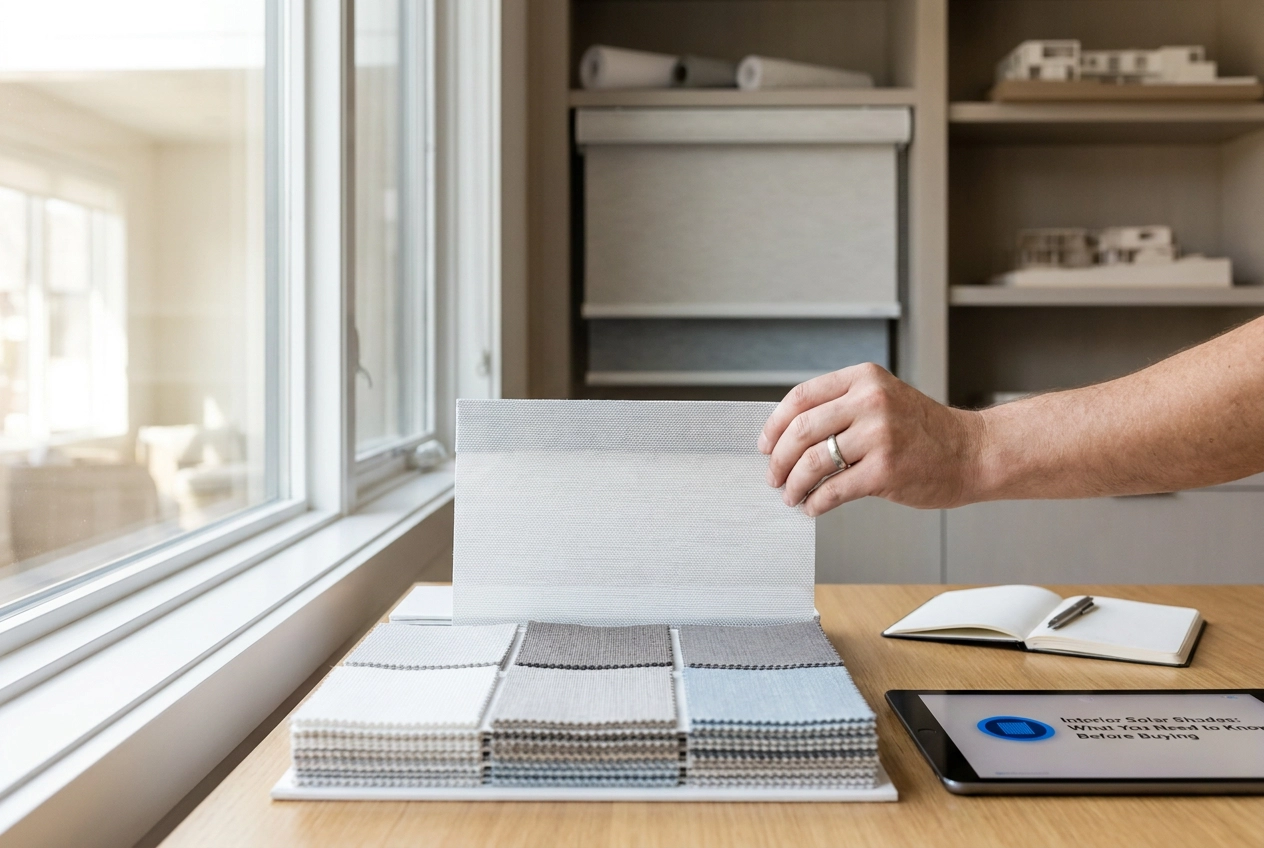
Picking the wrong openness level is a surprisingly easy mistake, especially without seeing the fabric in person first. A side-by-side comparison resource like this one can help, but nothing replaces an in-person assessment that accounts for your window’s orientation, the room’s purpose, and how the sun angle shifts across seasons. A professional evaluation before you order prevents an expensive do-over later.
Fabric vs. Aluminum Solar Shades: A Side-by-Side Look
Now that you understand the openness factor, it’s time to tackle the other big decision: what material are you actually getting? Fabric and aluminum solar shades work differently, look different, and serve different rooms, so a quick side-by-side breakdown makes choosing a lot easier.
Fabric Solar Shades: The Go-To for Most Homes
Fabric solar shades are the clear frontrunner for residential spaces, and it’s easy to see why. They’re typically woven from polyester or fiberglass mesh and come in a wide range of colors, textures, and opacities to match just about any room’s style. Their main strengths are UV protection, glare reduction, and preserving that soft, natural feel inside your home. They blend seamlessly into traditional, transitional, and modern interiors alike, which is a big reason they dominate the residential market.
Sustainability is another growing advantage here. Leading suppliers now offer 150 or more eco-certified fabric options, responding to homeowners who want window coverings that align with greener values. If you care about sustainable materials, fabric shades have come a long way and give you plenty of options to choose from.
Aluminum Solar Shades: Built for Serious Heat
Aluminum solar shades take a different approach. Instead of absorbing sunlight, their metallic reflective mesh bounces radiant heat away from the glass before it ever enters the room. That makes them especially effective in climates with intense heat or rooms with heavy afternoon sun from a western exposure. They outperform fabric shades on raw heat rejection, which is a meaningful advantage in the right situation.
The tradeoff is aesthetics. Aluminum shades have a more industrial, metallic appearance that fits well in contemporary or minimalist spaces but can feel out of place in a cozy traditional living room or a warmly decorated bedroom.
The Cost Reality
Fabric interior solar shades from national retailers start around $290 per window, while aluminum options and motorized configurations typically run higher. National brands also come with longer lead times. A local provider like Sparkletechsunscreens can deliver professional installation and same-week service, giving you comparable quality without the wait.
How Much Can Interior Solar Shades Actually Save on Energy Bills?
Let’s talk numbers, because this is where interior solar shades really make a case for themselves beyond just looking good.
Windows are responsible for roughly 45% of a home’s heat gain or loss, even though they make up only about 8% of the exterior surface. That’s a wildly disproportionate impact, and it means that anything you put on a window has an outsized effect on your energy bill. The U.S. Department of Energy estimates that interior window coverings can reduce solar heat gain by 40% to 77%, depending on the shade type and openness factor you choose. For context, that directly translates to less work for your air conditioner during summer months, which is where most homeowners feel the pain in their utility bills.
According to ENERGY STAR guidance, window treatments that manage solar heat gain can lower residential cooling costs by 7% to 15% annually in sun-heavy climates. If you live in a state with a long cooling season, those percentages add up to real dollars over the course of a year. A household spending $200 monthly on cooling could realistically recover $14 to $30 every single month just from smarter window coverage.
There’s also a benefit that most buyers completely overlook when calculating value: UV protection for your belongings. Solar shades block the UV radiation that fades hardwood floors, bleaches furniture fabric, and degrades artwork over time. Replacing a sun-damaged sofa or refinishing discolored flooring is expensive. Solar shades quietly prevent that cost from accumulating, even though it never shows up on an energy bill.
The market data reflects how seriously homeowners are taking this. The global solar shades market is valued at $7.23 billion in 2026, projected to reach $11.20 billion by 2034, with energy efficiency cited as the primary driver. These are utility-cost decisions, not just decorating ones.
If your home has large-format windows or floor-to-ceiling glazing, the stakes are even higher. Solar shades deliver year-round energy savings that scale with your window square footage, making them a proportionally smarter investment the more glass your home has.
Motorized Solar Shades and Smart Home Integration: Is It Worth It?
If you’ve made it this far in your solar shade research, you’ve probably wondered whether upgrading to a motorized system is actually worth the extra investment. The honest answer depends on your windows, your lifestyle, and how hands-on you want to be with your window treatments.
Motorized interior solar shades can be programmed to raise and lower on a set schedule, respond to sunlight intensity sensors, or even sync with your thermostat. When indoor temperatures rise, your shades lower automatically to cut solar heat gain before your air conditioner has to work harder. That kind of consistent, automatic response is something most of us simply won’t replicate by hand, and that consistency is exactly where the energy savings come from. Remote-operated and motorized blinds have been associated with energy bill reductions of up to 25%, specifically because automated shades actually respond every time rather than being skipped during a busy morning.
On the smart home side, most motorized solar shades in 2026 connect natively to Amazon Alexa, Google Home, and Apple HomeKit, which means your shades can work alongside your lighting, climate control, and security systems through a single voice command or app. Smart home integration is identified as one of the top demand accelerators in the global solar shading market, and it’s easy to see why once you experience everything working together.
The practical case gets even stronger when you think about hard-to-reach windows. Skylights, high transom windows, and oversized picture windows are genuinely difficult to adjust manually, and motorized systems solve that problem completely while also eliminating cords, which is a real safety win for homes with kids or pets.
That said, motorized systems do cost more upfront. If you’re not ready to go that route, manual roller solar shades with a quality tensioning system still deliver the same core UV blocking, glare reduction, and heat control that the fabric itself provides. The automation layer adds convenience and optimizes consistency; the shading performance starts with the fabric regardless.
Maintaining Interior Solar Shades: What Upkeep Really Looks Like
Once you’ve invested in quality interior solar shades, keeping them performing well comes down to one simple truth: the same open weave that filters light also catches everything floating in your air. Dust, pollen, and pet dander work their way into the mesh over time, and in kitchens specifically, airborne cooking grease acts like a magnet that makes those particles stick. Left unaddressed, this buildup gradually reduces how much light passes through and can cause visible discoloration that becomes permanent if ignored too long.
The good news is that routine care is genuinely simple. For fabric shades, start with light dusting or a low-suction vacuum pass using a soft brush attachment. For localized spots, a mild soap solution and a soft damp cloth are your best tools. What you want to avoid is soaking the fabric, since saturation can distort the weave geometry and damage any protective coatings. Abrasive cleaners and scrubbing pads are also off-limits; the weave structure is more delicate than it looks, and mechanical damage permanently changes how light moves through it. Graber’s cleaning guidance explicitly warns against full immersion for exactly this reason.
Here’s where routine DIY care hits its limit, though. Fine pollen, submicron dust, and polymerized kitchen grease embed deep into the mesh in ways that a damp cloth simply cannot reach. Professional screen cleaning removes those embedded particulates, restores light transmission performance, and meaningfully extends the life of the fabric. Sparkletechsunscreens offers this service alongside installation, which makes it easy to build into your overall maintenance plan rather than tracking down a separate provider.
Aluminum mesh shades are more forgiving on the cleaning front since their non-porous surface resists dust adhesion and typically just needs a damp wipedown. The area that deserves more attention with aluminum shades is the hardware: roller tubes, brackets, and cord mechanisms all experience wear over time. Per AAA Blind & Shutter’s maintenance tips, bracket and cord failures are among the most common service calls for otherwise well-maintained shades, so catching wear early is genuinely cost-effective.
For both fabric and aluminum options, scheduling an annual cleaning and inspection is the simplest protection strategy available. Time it after high-pollen season wraps up, or immediately following any nearby construction activity, when silica dust and fibrous particles are at their worst. A small investment in consistent upkeep protects the much larger investment you made in the shades themselves.
How Interior Solar Shades Work Alongside Bug Screens and Screen Doors
Here’s something that surprises a lot of homeowners: interior solar shades and bug screens don’t compete with each other at all. They sit on completely opposite sides of your window and handle completely different problems. Your bug screen lives on the exterior, keeping insects out while letting fresh air flow through. Your interior solar shade lives inside, filtering heat, glare, and UV rays before they hit your furniture and your face. Both systems do their jobs simultaneously without getting in each other’s way.
Entryways and Screen Doors: A Smart Combination
If your home has a screen door, you already know how much ventilation it adds to your entryway. What a lot of people miss is the opportunity to install interior solar shades on the sidelights or transom windows flanking that door. Those glass panels next to your front door can funnel serious heat into your entryway, especially in the afternoon. A solar shade on a sidelight handles that heat gain from the inside while your screen door keeps doing its job of circulating fresh air. The two systems work in parallel, not in conflict.
Fix Your Screens First
Before you invest in interior solar shades, it’s worth taking a close look at your existing bug screens and screen door. Torn mesh, bent frames, or dried-out spline create small gaps that let in moisture, dust, and outdoor debris. That same grime can settle on your shade fabric over time, and in some cases warp or stain it. Addressing those issues first protects your new investment. You can learn more about how interior and exterior screen systems compare to understand the full picture before making any decisions.
Sparkletechsunscreens handles rescreening and screen door repair as core services, so you don’t have to coordinate two separate contractors or two separate timelines. Refreshing your screens and adding interior solar shades can happen as one coordinated upgrade.
The Layered Approach That Actually Works
When you combine well-maintained exterior bug screens, a functional screen door, and quality interior solar shades, you end up with a genuinely layered system. Your screens handle ventilation and pest exclusion. Your shades handle heat and UV management from the inside. The result is year-round access to fresh air without sacrificing comfort or your energy bills.
Choosing the Right Interior Solar Shade for Your Home
Pulling everything together, here is a simple decision framework to help you land on the right setup for your home.
Match your openness factor to your window’s sun exposure first. South- and west-facing windows take the hardest direct sunlight throughout the day, so a tighter 1–3% weave gives you the strongest heat and UV control where you need it most. North- and east-facing windows get softer, more diffuse light, making a 5–10% openness factor a better fit since it preserves your view without sacrificing comfort. You can learn more about how openness factor and fabric color interact before making a final call.
Next, choose your material based on the room’s demands. Fabric shades offer the most aesthetic flexibility and increasingly include sustainable, PVC-free options. For extreme heat exposure, aluminum-backed shades deliver superior solar reflectivity. For hard-to-reach windows or smart home integration, motorized shades make daily operation effortless; manual roller shades still perform exceptionally well and cost significantly less upfront.
Finally, pair your interior solar shades with maintained exterior bug screens and a working screen door system for complete, layered window protection. Sparkletechsunscreens offers same-week service for solar screen installation, rescreening, screen door repair, and professional screen cleaning. Contact the team to assess your windows and get the right solution installed quickly, without a long wait.
Conclusion
Interior solar shades are one of the smartest upgrades you can make for your home’s comfort and style. To recap the key points: openness level determines how much light and visibility you get, material quality affects durability and heat reduction, and the right style depends on your specific room needs and budget. Together, these factors make all the difference between a shade you love and one you regret.
Now that you have the knowledge, it is time to put it to work. Measure your windows, identify your biggest pain points (glare, heat, or privacy), and use those priorities to guide your choice.
You deserve a home that feels comfortable in every season without sacrificing natural light. The perfect interior solar shade is out there waiting for you. Go find it.