

Here’s something most people never think about until they’re staring at a screen so grimy they can barely see the backyard: window screens actually need regular cleaning. Surprise!
If you’ve ever wondered how often to clean window screens, you’re definitely not alone. It’s one of those household tasks that quietly gets pushed to the back of the to-do list, season after season, until suddenly you realize your “fresh air” is being filtered through a wall of dust, pollen, and mystery debris.
The good news? Keeping your screens clean doesn’t have to be complicated or time-consuming. In this guide, we’re breaking it all down season by season so you know exactly when to grab that bucket and scrub brush. You’ll learn which times of year demand the most attention, what to look out for in each season, and how to build a simple routine that keeps your screens looking great year-round.
Whether you’re a first-time homeowner or just someone finally getting serious about home maintenance, this guide has everything you need to get started.
The Short Answer: A Three-Tier Cleaning Schedule
The good news? You don’t need to pick a single answer for how often to clean window screens. A simple three-tier schedule covers everything, and each tier is a lot lighter than you might expect.
Tier 1: Monthly (The Quick Vacuum Pass)
Once a month, grab your vacuum and attach the brush head. Run it over the surface of each screen without removing anything from the frame. This takes under five minutes per screen, and on a good day, closer to one or two minutes. You’re pulling off loose dust, pollen, pet hair, and cobwebs before they get pushed deeper into the mesh. Think of it as the low-effort step that keeps the bigger jobs manageable. According to Easy Ways to Maintain Clean Screens on Your Windows, this kind of light, routine maintenance is what prevents buildup from ever reaching the stubborn stage.
Tier 2: Every 3 Months (The Rinse-Down)
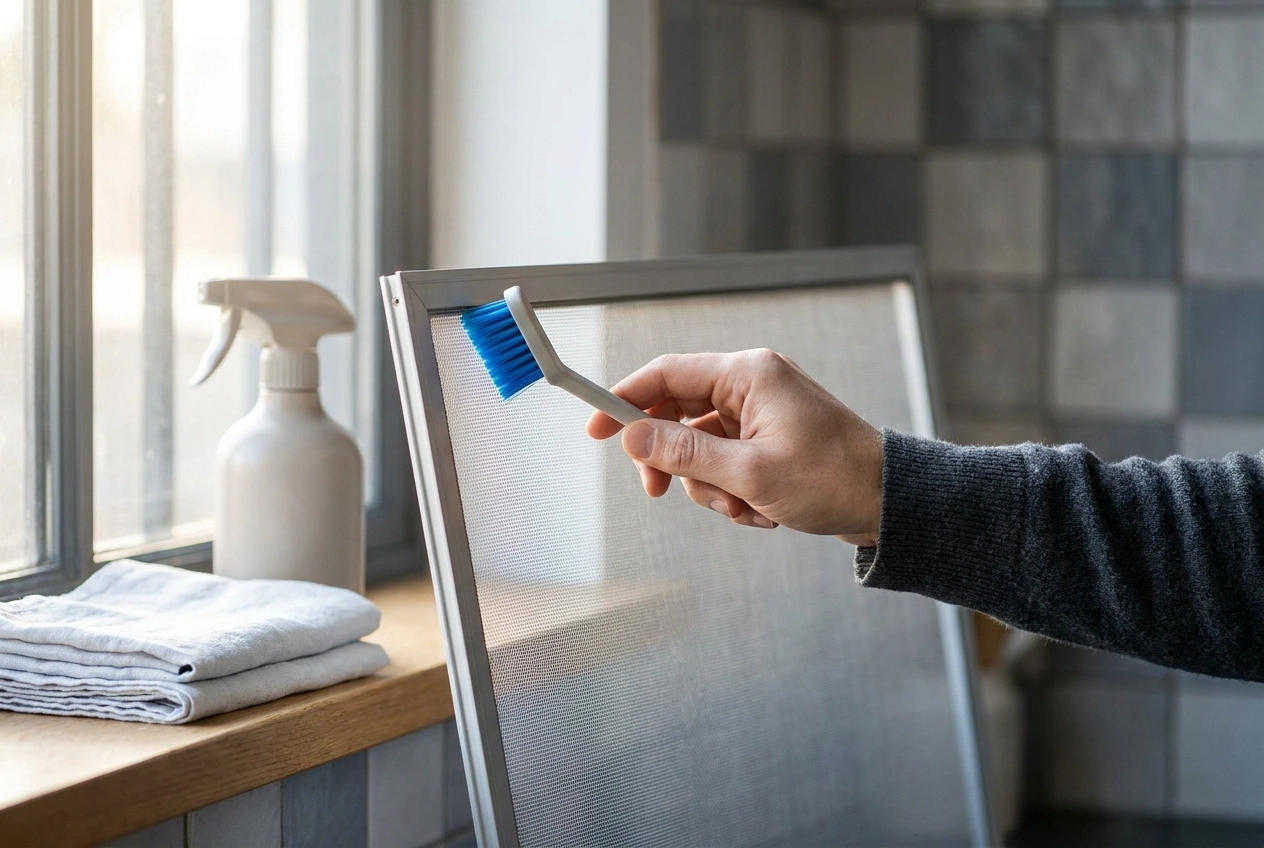
Four times a year, step it up with a mild dish soap solution and a garden hose. Spray from the top down, scrub gently with a soft brush on any sticky spots, and rinse clean. This tackles the buildup that vacuuming simply can’t reach, especially after spring pollen season or fall leaf drop when organic debris sticks aggressively to the mesh. You still don’t need to pull the screens out of the frame for this step.
Tier 3: Twice a Year (The Deep Clean)
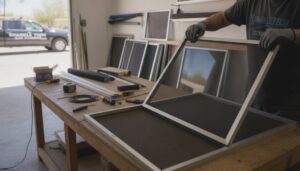
In late spring and early fall, do a full removal. Lay each screen flat on a soft surface, scrub both sides with a brush and soapy water, rinse thoroughly, and let it dry before reinstalling. This is also your chance to check for small tears, bent corners, or loose spline. How Often You Should Clean Your Window Screens reinforces that biannual attention catches early damage before it becomes a costly repair.
Why This Approach Works
The tiered system prevents any single session from turning into a weekend project. It also protects the mesh itself. When you skip the monthly pass, grit and debris compact into the fibers. Then during the deep clean, even gentle scrubbing can grind that embedded grit against the mesh, creating micro-tears that shorten the screen’s lifespan. Staying consistent with all three tiers keeps your screens in shape longer and pushes back the need for a full rescreen job.
Why Screen Cleaning Frequency Matters More Than You Think
Most homeowners think of screen cleaning as a cosmetic task, something to tackle when the mesh looks visibly grimy. But the real reasons to stay on top of it go much deeper than appearances, and understanding them makes it a lot easier to stay motivated.
According to the EPA’s Indoor Air Quality guidelines, window screens are among the most accessible ventilation surfaces in any home. When mesh gets clogged with dust and debris, it acts less like a filter and more like a wall, restricting the fresh airflow that helps dilute indoor pollutants. Think of it the same way you think about a dirty HVAC filter: once it’s clogged, air quality drops and efficiency follows. Clean screens are essential for air quality in a way that most people simply don’t connect to this one simple chore.
Natural light is another quiet casualty of neglected screens. Dust, pollen, and mold spores build up gradually across the mesh, and the dimming effect happens so slowly that most people never notice it. Until they clean the screens, that is. The difference is usually striking.
Rain makes the problem worse in a specific, practical way. When water hits a dirty screen, it carries that accumulated grime straight onto your window glass. Over time, that speeds up exterior glass degradation and means you end up cleaning your windows far more often than you would otherwise.
For allergy sufferers, there is a more personal reason to care. Pollen, dust mites, and mold spores collect in screen mesh and get pushed directly indoors by a passing breeze. Keeping screens clean is a legitimate part of reducing allergen exposure inside your home.
Finally, the longer you wait, the harder the job gets. Debris binds to mesh fibers over time, turning a quick rinse into a serious scrubbing project. Window screen maintenance done consistently takes a fraction of the effort compared to periodic deep remediation. A little done regularly beats a lot done rarely, every time.
Does Your Climate Change How Often You Should Clean?
The short answer is yes, and it can make a meaningful difference in how long your screens last.
If your home sits near a highway, construction zone, agricultural land, or even a golf course, debris accumulates on your mesh much faster than it does for a typical suburban home. In those situations, you’ll want to shift your standard quarterly rinse to roughly every 6 to 8 weeks. The extra exposure to exhaust, dust, pollen, and airborne particles simply means your screens hit “dirty” faster.
Hard water is another big factor. In parts of Utah, Arizona, Nevada, and the broader Southwest, water hardness regularly exceeds 300 mg/L of calcium carbonate. At those levels, mineral deposits don’t just sit on your screen surface; they can etch into it permanently if left too long. A 60 to 90 day cleaning cycle is strongly recommended in these regions, both for your screens and for the glass behind them.
Desert and Sun Belt climates add something else to the list: UV damage. Southern California, for example, sees 280-plus days of sun exposure annually, and that intensity weakens fiberglass mesh faster than in cooler climates. Inspecting your screens during every cleaning session matters more here than anywhere else. On top of that, arid environments produce fine particulate that packs into mesh pores more densely than typical dust, so a more thorough rinse is needed, not just a quick vacuum pass.
Coastal homeowners face a completely different challenge. Salt air is hygroscopic, meaning it holds moisture against your frames long after the sea breeze passes. That constant dampness accelerates corrosion on aluminum frames and eats away at the spline, the rubber gasket that holds your mesh in place. For coastal homes, inspecting your frames and spline at every deep clean is not optional; it is the whole point.
Solar Screens: Do They Need a Different Cleaning Schedule?
If you have solar screens on your windows, the standard three-tier schedule still applies, but there are a few important tweaks worth knowing about before you grab the hose.
Solar Screens Trap More Debris by Design
Solar screens use a denser, tighter mesh weave than standard bug screens. That tighter weave is what gives them their sun-blocking power, but it also means they catch more airborne dust, pollen, and debris per square inch than a regular screen would. Because of this, the monthly vacuum pass is even more important for solar screens than it is for standard mesh. A quick once-over with a brush attachment every few weeks keeps the buildup from packing into those tiny openings and working against your screen’s performance.
The Quarterly Rinse Is a Performance Issue, Not Just a Cosmetic One
Here is where solar screens differ most noticeably from standard bug screens. When a regular screen gets clogged, it looks dirty. When a solar screen gets clogged, it actually loses its ability to block heat effectively. That means your home gets warmer, your air conditioning works harder, and the whole reason you installed solar screens in the first place starts to slip away. Staying consistent with your quarterly rinse is not optional for these screens; it is part of keeping them functional.
Use Lighter Pressure When Rinsing
This one matters more than most people realize. High-pressure spray can stretch or distort the tighter weave of solar screen mesh, and once that mesh is stretched, it does not snap back. The fit gets loose, the frame seal weakens, and the screen’s heat-blocking performance drops permanently. Stick with a gentle fan spray from a garden hose, working from top to bottom, and let the water do the work without forcing it.
Skip the Ammonia Cleaners Entirely
Mild dish soap and water is all you need, and that is intentional. Ammonia-based cleaners degrade fiberglass mesh over time, and many solar screens use coated fiberglass or specialty materials that are especially vulnerable. Even a few cleaning sessions with the wrong product can shorten your screen’s lifespan significantly. Check the label before you use anything beyond basic dish soap, and when in doubt, leave it out.
Do a Light Inspection After Every Cleaning
Once your solar screen is clean, hold it up to natural light and look across the mesh surface. Any spots where the mesh has loosened or pulled slightly away from the frame will catch more debris and degrade faster than the surrounding mesh. Catching these areas early means you can plan ahead rather than being surprised by a screen that suddenly needs full replacement. It only takes a few seconds and can save you a repair call down the road.
Screen Doors Get Dirtier Faster — Here Is Why That Changes the Schedule
Window screens mostly just sit there. Screen doors get lived in. Every time someone pushes through with groceries, every time a dog paws at the mesh to come inside, every time a kid grabs the frame with sticky hands, that door picks up a fresh layer of oils, dirt, and debris. That contact-based grime builds up far faster than the environmental dust and pollen that settles onto window screens passively. It is a different surface with a different job, and it needs a different schedule to match.
How Often Screen Doors Actually Need Attention
For an active household, a monthly wipe-down of the frame and a quick brush pass over the mesh is the floor, not the goal. If you have pets or young children, bump that up to every two to three weeks. Dogs pressing their noses against the mesh and kids pushing at handle height means the soiling cycle is much shorter. A 30-second pass with a dry brush each week can also prevent buildup from compounding between full cleanings.
The Lower Half Is Where Damage Starts
Check the bottom half of your screen door at every single cleaning, not just seasonally. That zone takes the most abuse from paws, feet, and frame scuffs, and small tears or stretched mesh in that area are easy to miss until a gap opens up and bugs find it. Bent lower corners can also cause the door to sit unevenly in its track.
While you are inspecting, give the spline a look too. Spline is the rubber gasket pressed into the channel around the frame perimeter that keeps the mesh held under tension. On screen doors, repeated opening, closing, and impact causes it to loosen and compress faster than on a window screen. At each quarterly cleaning, run a finger along the channel and confirm the spline sits flush. If it has crept out or cracked, it needs to be reseated before the mesh loses tension entirely.
If the mesh is already sagging or bowing outward, no amount of cleaning will fix that. Sagging means the mesh has lost tension, and that is a rescreening situation. Cleaning a saggy screen just makes a saggy screen look slightly less dirty. For more details on essential fall maintenance for window and door screens, inspecting spline and mesh tension at the change of seasons is the right habit to build before small issues become full replacements.
What to Inspect Every Time You Do a Deep Clean
A deep clean is the perfect moment to give your screens a real once-over, because once they’re out of the frame and freshly rinsed, problems that were invisible before suddenly become obvious. Run through these five checks every single time.
1. Check all four corners of the frame. Press lightly on each corner and look for bending, cracking, or any gap where the frame has pulled apart. Bent corners break the seal between the screen and the window opening, which means bugs and debris can squeeze right past the mesh without touching it. Corner damage is easy to miss when a screen is installed and dirty, but it shows up clearly once the screen is in your hands.
2. Feel along the spline channel. Run a finger around the full perimeter of the groove that holds the mesh in place. The rubber spline should feel soft, seated firmly, and continuous. If it feels hard, crumbly, or is pulling away from the groove anywhere, that is the most common reason screens fit loosely or fall out entirely.
3. Hold the screen up to natural light. With the light source behind it, look for pinholes, small tears, or spots where the mesh looks uneven. These are nearly impossible to catch on a dusty, installed screen, but they pop right out on a clean, backlit one.
4. Look for discoloration that soap and water cannot remove. Yellowing or brittleness in fiberglass mesh after a thorough cleaning usually signals UV degradation, not surface grime. That is a sign the mesh is wearing out structurally and may need replacement soon.
5. Skip any ammonia-based cleaners. Ammonia breaks down fiberglass mesh fibers at a chemical level, and the damage compounds every time you clean. Stick to mild dish soap and water instead.
When Cleaning Is No Longer Enough: Signs You Need Rescreening
Sometimes a screen just needs a good rinse. Other times, cleaning it again is just postponing the inevitable. Knowing the difference saves you time and keeps bugs and debris where they belong: outside.
Here are the key signs that your screen has moved past a cleaning problem and into repair territory.
1. The mesh sags or sits wavy after cleaning. If your screen looks like a hammock instead of lying flat and taut, the spline has lost tension and the mesh can no longer seal properly against the frame. No amount of scrubbing corrects this. It is a structural failure, and the screen will continue to gap at the edges until it is rescreened with fresh mesh and new spline.
2. You can see holes or tears larger than a pinhole. Any opening bigger than a tiny pinhole is an open invitation for insects. According to Rite Screen’s guide on torn mesh, small pinholes may be patchable, but multiple holes, long rips, or mesh that has separated from the spline channel means the screen is no longer doing its job regardless of how clean the rest of it looks.
3. The spline is hardened, cracked, or pulling away from the frame. The spline is the rubber gasket that holds mesh to the frame, and it degrades on its own timeline. Once it hardens and shrinks, it cannot be pressed back into place. The mesh will keep loosening until the screen eventually falls out entirely.
4. The mesh feels brittle or looks faded and chalky. UV exposure breaks down fiberglass at the fiber level. As noted in this overview of screen replacement timelines, mesh that looks faded or shiny has already lost its coating and will tear under even gentle cleaning pressure. Replacing it now prevents debris from entering through failing material later.
5. A single rescreening appointment fixes all of it at once. New mesh, fresh spline, and a frame check means the screen is essentially new again, ready for a full cleaning cycle and years of reliable use. Same-week appointments are often available, so there is no reason to keep working around a screen that has already given out.
Keep a Simple Schedule and Your Screens Will Last
The three-tier cadence really does work as a complete system. A quick monthly vacuum pass keeps debris from packing into the mesh. The quarterly rinse clears whatever the vacuum missed before it hardens into grime. And the biannual deep clean in late spring and early fall resets everything back to baseline. Each tier makes the next one easier, so skipping a step tends to snowball into a much bigger job down the road.
Your specific situation shifts the timeline slightly but never the approach. High-dust climates, solar screens with their denser weave, and screen doors that take daily physical contact all push toward the more frequent end of each tier. Standard bug screens on rarely-opened windows sit comfortably at the lighter end. The framework stays the same either way.
Every deep clean is also your damage check. Spline failure, which is the rubber cord around the frame pulling loose or going brittle, and small mesh tears are easy to spot on a freshly rinsed screen. Catching them early keeps bugs and allergens outside where they belong, and it is almost always cheaper to rescreen one panel than to deal with a full infestation.
If a deep clean reveals damage that cleaning alone cannot fix, professional screen cleaning and same-week rescreening are available to handle it quickly.
The best next step is a simple one: pick a recurring date for your quarterly rinse right now, before pollen season peaks, and drop a calendar reminder for late spring and early fall for your deep clean. Thirty seconds of planning today keeps your screens lasting years longer.
Conclusion
Clean window screens are a small detail that makes a big difference in your home’s air quality, appearance, and overall comfort. Here are the key takeaways to keep in mind: screen cleaning should happen at least twice a year, with spring and fall being the most important seasons; high-pollen and high-traffic periods may call for more frequent attention; and a simple routine now prevents stubborn buildup later.
The effort is minimal, but the payoff is real. Cleaner screens mean better airflow, more natural light, and one less thing quietly nagging at your to-do list.
Ready to get started? Pick the season you’re in right now and commit to one cleaning session this week. Once you build the habit, you’ll wonder why you ever let it slide. Fresh air and clear views are absolutely worth it.