
Table of Contents
- Why Desert Window Screen Materials Matter
- Fiberglass vs. Polyester vs. Metal Mesh: Material Comparison
- UV Resistance and Solar Protection in Desert Climates
- Solar Screen Fabric Density and Shade Factor
- Pet-Proofing and Tear Resistance for Active Households
- How to Install Solar Screens for Maximum Performance
- Energy Efficiency ROI and Cooling Cost Savings
- Choosing the Right Mesh for Your Phoenix or Scottsdale Home
Last Updated: August 10, 2026
Why Desert Window Screen Materials Matter
Arizona’s intense sun, extreme heat, and fine dust destroy ordinary screens in months. The right desert window screen materials survive temperatures exceeding 115°F, UV rays that degrade fiberglass rapidly, and dust that clogs standard mesh in weeks.
At SPARKLE TECH SUN SCREENS, we’ve installed thousands of screens across Phoenix and Scottsdale. Material choice determines whether your screens last two years or twenty. A standard fiberglass screen fails in desert heat, while a properly selected solar screen reduces cooling costs while blocking glare and protecting furnishings from fading.
This guide covers materials that perform in Arizona’s climate: fiberglass, polyester, and metal mesh options. You’ll understand UV resistance, thermal expansion, and shade factors that help rather than just darken your home.
Fiberglass vs. Polyester vs. Metal Mesh: Material Comparison
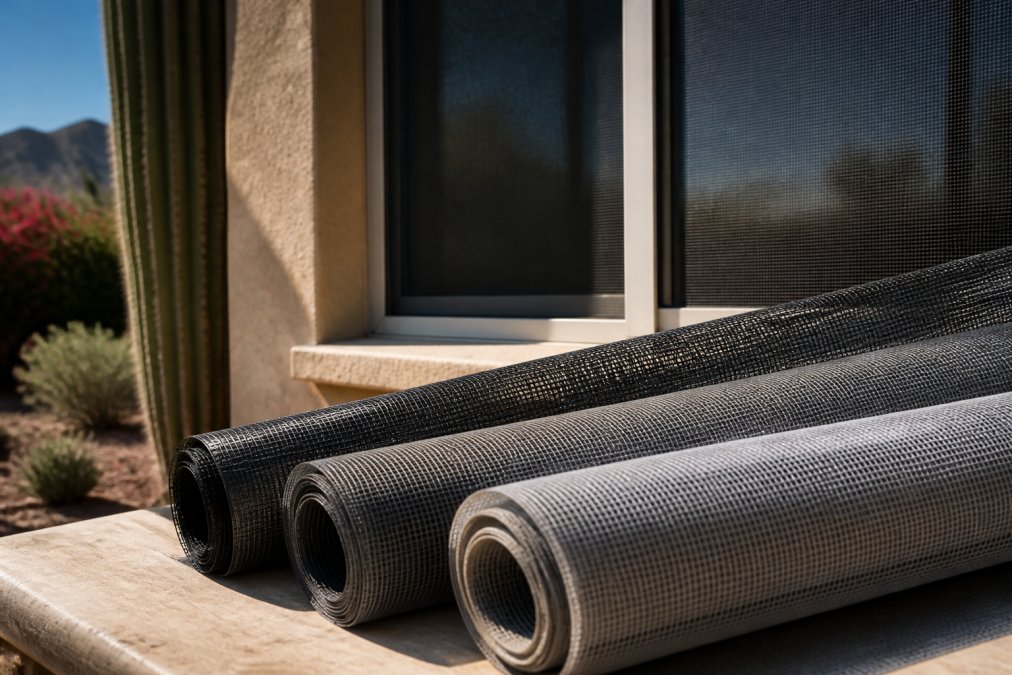
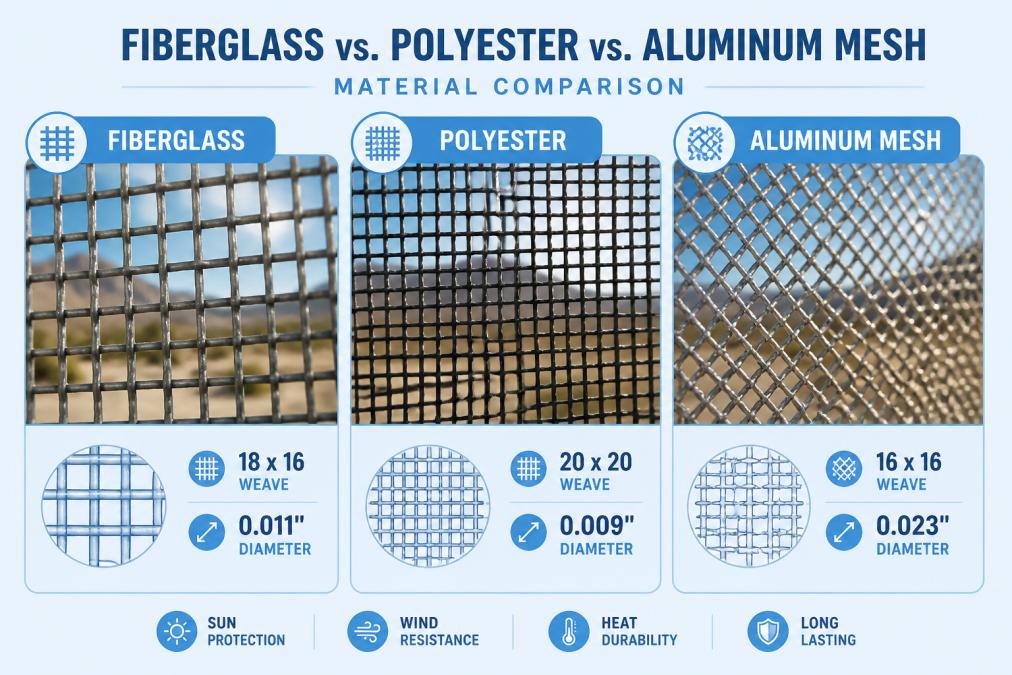
Three core material families dominate desert screening: vinyl-coated fiberglass, heavy-duty polyester, and metal alloys.
Vinyl-Coated Fiberglass: Durability and Strength
Vinyl-coated fiberglass is the most common choice for desert homes. The fiberglass core provides structure while the vinyl coating protects against UV degradation and heat absorption. Phifer Super Solar Screening blocks up to 90% of the sun’s heat and glare, making it exceptionally effective for homes prioritizing thermal control.
The material’s real advantage is handling thermal expansion. Desert temperatures swing 40+ degrees between day and night. Vinyl-coated fiberglass flexes with these swings without cracking or warping like metal alternatives sometimes do.
Where vinyl-coated fiberglass excels:
- Blocks significant solar heat (70-90% depending on density)
- Resists UV degradation better than untreated fiberglass
- Handles thermal expansion without warping
- Maintains structural integrity in extreme heat
- Easier to install than metal mesh alternatives
The trade-off is visibility. Higher-density solar screens that block maximum heat naturally reduce outward visibility. For homeowners prioritizing energy savings over panoramic views, this is the right material.
Heavy-Duty Polyester: Tear Resistance and Longevity
Vinyl-coated polyester screens like Phifer TuffScreen offer three times the tensile strength of standard fiberglass. The heavier weave resists tears from impacts, pet claws, and wind-driven debris, a real concern in Arizona’s monsoon season.
Polyester maintains flexibility across temperature ranges. While fiberglass can become brittle in extreme heat, polyester stays consistent. Heavy-duty polyester is best for homes with active pets or children, areas prone to wind-driven impacts, and situations where replacement costs matter.
The limitation is that standard heavy-duty polyester doesn’t block as much solar heat as specialized solar screens. You’re trading thermal control for durability.
Aluminum and Bronze Mesh: Metal Alloy Options
Aluminum screens offer exceptional strength and won’t sag or stretch over time like fiberglass eventually does. Bronze mesh, a copper-zinc alloy, provides superior corrosion resistance and develops a distinctive patina appealing to homeowners seeking aesthetic distinction.
Metal mesh works best for historic homes where traditional aesthetics matter, coastal or high-dust environments where corrosion resistance is critical, and situations where screen sagging is a concern.
The downsides are significant. Metal mesh is substantially more expensive than fiberglass. Installation requires more skill because the material is less forgiving. Aluminum can become uncomfortably warm to the touch in direct sun.
| Material | Heat Blocking | Durability | Visibility | Best For | Cost |
|---|---|---|---|---|---|
| Vinyl-Coated Fiberglass | 70-90% | Moderate (5-7 years) | Good to Fair | Energy savings, solar control | Budget-friendly |
| Heavy-Duty Polyester | 40-60% | High (8-12 years) | Good | Pet owners, active households | Moderate |
| Aluminum Mesh | 30-50% | Very High (15+ years) | Excellent | Strength priority, sagging prevention | Higher |
| Bronze Mesh | 30-50% | Very High (20+ years) | Excellent | Historic homes, corrosion resistance | Highest |
UV Resistance and Solar Protection in Desert Climates
Desert UV exposure is roughly 40% more intense than coastal regions at the same latitude. Standard fiberglass screens degrade visibly within 18-24 months. The vinyl coating on quality solar screens is engineered to absorb and dissipate UV radiation rather than allowing it to break down the fiberglass underneath.
Vinyl-coated fiberglass screens designed for solar protection incorporate additives that reflect and absorb UV wavelengths before they reach the fiberglass core, extending usable life to 7-10 years compared to 2-3 years for standard screens.
Heat Absorption and Thermal Expansion
Arizona screens experience thermal stress most homeowners don’t consider. A screen in direct sun reaches 160°F+. At night, it drops to 60°F. That’s a 100-degree swing daily, repeated thousands of times over the screen’s life.
Vinyl-coated fiberglass handles this better than alternatives because the vinyl coating has high thermal flexibility. It expands and contracts with the fiberglass without creating stress points. Metal screens can develop micro-fractures at connection points where thermal expansion rates differ between mesh and frame.
Glare Reduction and Light Transmission
A screen blocking 90% of solar heat also blocks roughly 90% of visible light, creating significant darkening indoors. Mid-range solar screens blocking 70% of heat reduce light transmission by roughly 70%, noticeably darker but still usable. Standard screens blocking 40-50% of heat maintain much better visibility while providing meaningful solar control.
Test the visibility difference before committing. Many screen suppliers have sample panels you can hold up to your window. Spending 20 minutes evaluating the darkness level in your actual room beats discovering post-installation that your living room feels like a cave.
Solar Screen Fabric Density and Shade Factor
Shade factor is the percentage of solar radiation a screen blocks. It’s the single most important specification when choosing desert window screen materials. A 90% shade factor means 90% of the sun’s heat and light are blocked. A 50% shade factor means roughly half get through.
Understanding Mesh Gauge and Airflow Permeability
Mesh gauge describes the number of fibers per inch in the weave. A tighter weave (higher gauge number) blocks more heat and light but restricts airflow. Standard screens typically use 16-18 gauge mesh. Solar screens use 18-20 gauge or denser.
A 20-gauge solar screen blocks dust more effectively than 16-gauge standard mesh because the tighter weave filters finer particles. Dense solar screens sacrifice some airflow for heat control. In Arizona’s climate, this is usually an acceptable trade-off.
Dust and Sand Filtration Ratings
Phoenix dust is finer and more persistent than most regions experience. Standard screens with 16-gauge mesh allow much of this dust to pass through. A denser solar screen (18-20 gauge) provides meaningful filtration.
Dust accumulation reduces visibility and airflow over time. A tighter weave slows this accumulation, extending the interval between cleanings from weeks to months. For most Phoenix homes, 18-gauge solar screens provide the right balance, meaningful dust blocking while maintaining adequate ventilation and visibility.
Mesh density directly affects maintenance burden. Tighter weaves filter more dust but require more frequent cleaning. Looser weaves allow more dust through but stay cleaner longer. Choose based on how much maintenance you’re willing to do.
Pet-Proofing and Tear Resistance for Active Households
Standard fiberglass screens tear easily under pet claws or impact. Phifer PetScreen is seven times stronger than standard insect screening, engineered specifically for this problem. The material resists punctures and tears from pet claws while maintaining reasonable visibility and airflow.
Pet-resistant screens are best for homes with dogs, cats, or both, and situations where screen replacement costs accumulate quickly. The material performs well in desert heat, maintaining tear resistance even at 130°F.
The limitation is that pet-resistant screens don’t provide solar heat blocking. Some homeowners use pet-resistant screens on doors and windows where pets access, and solar screens on windows where heat control is the priority.
How to Install Solar Screens for Maximum Performance
Professional installation matters more than most homeowners realize. A poorly fitted screen creates gaps that defeat its purpose. A screen with incorrect spline tension fails prematurely.
SPARKLE TECH SUN SCREENS handles custom sizing and installation for Phoenix and Scottsdale homes, ensuring screens fit precisely and perform as designed.
Custom Sizing and Screen Spline Installation
Screen spline is the rubber cord that holds the screen mesh in the frame. The spline must be seated firmly enough to hold the mesh without slipping, but not so tight that it damages the mesh or frame.
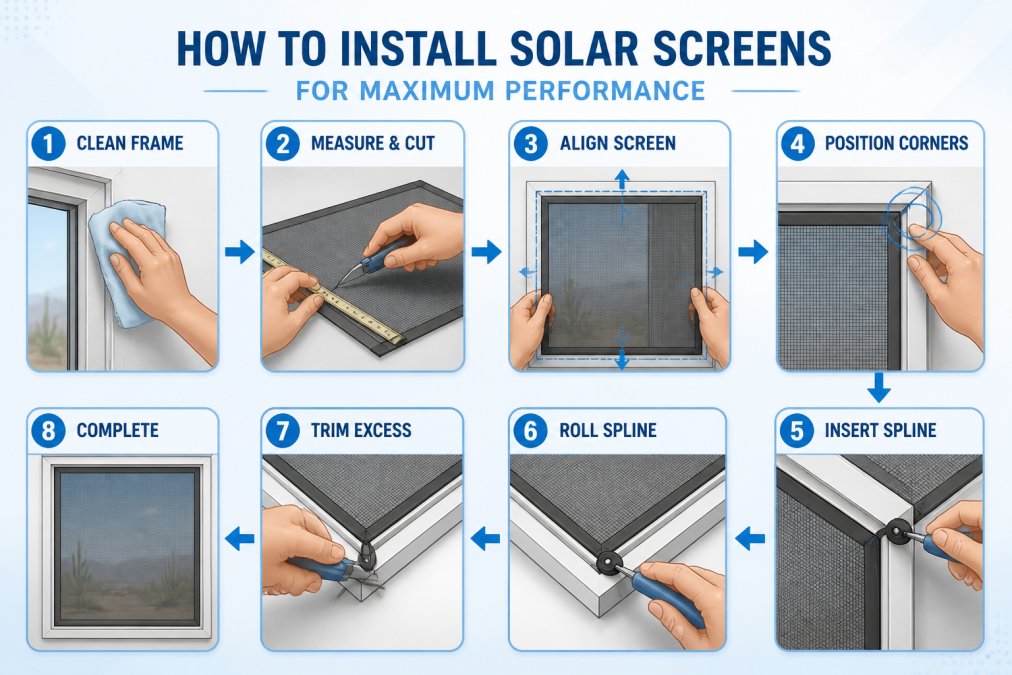
The installation process:
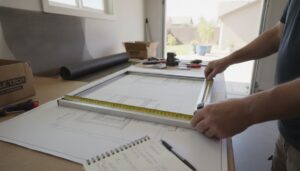
- Measure the frame opening precisely (measure three points vertically and horizontally to account for out-of-square frames)
- Cut mesh slightly larger than the frame (roughly 2 inches oversized on all sides)
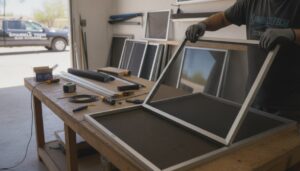
- Lay the mesh over the frame and press it into the groove using a spline roller tool
- Insert the spline into the groove, pressing it firmly with the roller
- Trim excess mesh with a utility knife
Getting the mesh tension correct is critical. Too loose and the mesh sags, allowing insects through. Too tight and you risk tearing the mesh or cracking the frame.
Maintenance and Cleaning for Long-Term Durability
Desert screens accumulate dust and pollen rapidly. Cleaning every 4-6 weeks keeps them performing optimally.
Cleaning steps:
- Use a soft brush or vacuum with a brush attachment to remove loose dust
- Rinse gently with a garden hose (avoid high pressure, which can damage the mesh)
- For stubborn residue, use a soft cloth with mild soap and water
- Allow to dry completely before closing windows
Avoid abrasive scrubbing or high-pressure washing. Both can damage the vinyl coating or tear the mesh. Inspect screens seasonally for damage. Small tears can be patched with screen repair kits. Larger damage or significant sagging indicates replacement is needed.
Don’t ignore tears or holes. A small tear becomes a large one within weeks as the mesh continues to fray. Small holes let insects through despite the screen’s presence. Patch or replace damaged areas promptly.
Energy Efficiency ROI and Cooling Cost Savings
Solar screens reduce cooling costs by blocking heat before it enters your home. A home with significant south and west-facing windows in Phoenix typically sees 10-20% reductions in summer cooling costs from solar screens. A home spending $200 monthly on summer cooling might save $20-40 monthly with solar screens installed on primary sun-exposure windows.
If solar screens cost $500 installed and save $30 monthly, you break even in roughly 17 months. Screens lasting 7-10 years provide 5-8 years of pure savings after payback.
According to U.S. Department of Energy guidance on window coverings, window treatments that reduce solar heat gain can decrease cooling energy use by 10-25% depending on climate and window orientation. Arizona’s intense sun positions solar screens at the higher end of this range.
Choosing the Right Mesh for Your Phoenix or Scottsdale Home
The best desert window screen materials depend on your specific situation.
Choose vinyl-coated fiberglass solar screens if:
- Energy savings are your primary goal
- You can accept reduced visibility for maximum heat blocking
- Your budget is moderate
- You want the easiest installation process
Choose heavy-duty polyester if:
- You have pets or active children
- Durability and tear resistance matter more than solar control
- Screen replacement costs concern you
Choose aluminum or bronze mesh if:
- You prioritize strength and longevity above all else
- Your home’s aesthetics or historic character matter
- You’re in a high-dust or corrosive environment
- Budget allows for premium materials
For most Phoenix homeowners, vinyl-coated fiberglass solar screens with 18-gauge mesh balance heat control, durability, dust filtration, and cost effectively. Professional custom sizing ensures screens fit perfectly, eliminating gaps that reduce effectiveness. SPARKLE TECH SUN SCREENS provides custom sizing, professional installation, and a lifetime guarantee on qualifying installations.
Choosing desert window screen materials without understanding how they perform in Arizona’s extreme heat and UV exposure leads to expensive mistakes. The right approach is selecting materials engineered for desert conditions, then having them installed professionally to ensure perfect fit and performance. SPARKLE TECH SUN SCREENS provides custom sizing, professional installation, and a lifetime guarantee on qualifying services. Get your free quote today and discover how much your cooling costs could drop with properly selected desert window screen materials.
Frequently Asked Questions
What is the most durable window screen material for desert heat?
Heavy-duty vinyl-coated polyester and aluminum alloy screens outperform standard fiberglass in extreme desert conditions. Polyester resists thermal expansion and UV degradation better than fiberglass, while aluminum mesh resists sagging and maintains structural integrity under intense sun. Bronze (copper-zinc alloy) offers superior corrosion resistance, especially valuable in Arizona's dry climate. For maximum durability in desert window screen materials, choose polyester or metal mesh over standard fiberglass, and ensure the material has proven weatherability ratings for sustained temperatures above 120°F.
What is the difference between 80% and 90% solar screen fabric density?
The percentage refers to the shade factor, how much solar heat and UV light the screen blocks. An 80% solar screen blocks 80% of the sun's heat and glare, while a 90% screen blocks 90%. Higher density screens provide greater heat reduction and energy savings but also reduce outward visibility and darken interior spaces more noticeably. In desert climates, 90% screens are ideal for south and west-facing windows where heat gain is most intense, while 80% screens work better for east and north-facing windows where you want some natural light. Choose based on your window orientation and comfort preferences.
How do solar screens help reduce cooling costs in desert homes?
Solar screens block 70-90% of incoming solar heat before it enters your home, reducing the workload on your air conditioning system. By lowering indoor temperatures by 5-10°F without air conditioning running, you decrease energy consumption and lower monthly cooling bills. The shade factor and mesh density of your solar screen determine the cooling benefit, higher density screens provide greater heat reduction. Professional installation ensures proper fit and maximum thermal performance. Homes in Phoenix and Scottsdale typically see measurable energy savings within the first cooling season after installing quality solar screens on high-exposure windows.
Is fiberglass or aluminum screen better for intense sun exposure?
Aluminum mesh is superior for intense sun exposure in desert climates. While vinyl-coated fiberglass screens are affordable and offer good initial performance, aluminum resists UV degradation more effectively and maintains structural integrity under extreme heat without sagging or stretching. Fiberglass can experience thermal expansion and become brittle after prolonged UV exposure in temperatures consistently above 100°F. Aluminum's superior tensile strength and corrosion resistance make it the better choice for Arizona desert homes, especially on south and west-facing windows where sun exposure is most intense. Bronze (copper-zinc alloy) offers even better corrosion resistance but at a higher cost.
What window screen material works best for dust and sand filtration in the desert?
Tightly woven fiberglass mesh with a 20×20 gauge or higher provides excellent dust and sand filtration without severely restricting airflow. Heavy-duty polyester screens also perform well for dust filtration due to their dense weave and durable construction. The key is balancing mesh density, finer mesh blocks more dust but reduces ventilation. For desert homes, a solar screen with moderate density (70-80% shade factor) combined with a fine mesh gauge offers both heat protection and effective dust filtration. Regular cleaning and maintenance of your screen's surface prevents dust buildup and maintains long-term filtration effectiveness.
How often do desert window screens need replacement or maintenance?
Quality desert window screen materials can last 7-10 years with proper maintenance, though UV degradation and thermal stress may require earlier replacement in extreme conditions. Annual cleaning removes dust and debris that accelerate material breakdown. Inspect screens seasonally for tears, loose splines, or signs of UV degradation like brittleness or discoloration. Heavy-duty polyester and aluminum screens require less frequent replacement than standard fiberglass. Professional rescreening services can extend the life of your frame by replacing just the mesh without replacing the entire window screen frame, offering a cost-effective maintenance option for Arizona homeowners.
This article was written using GrandRanker