

There’s nothing quite as frustrating as a torn or damaged window screen. Bugs get in, fresh air flow gets blocked, and suddenly that peaceful breeze you were counting on turns into a mosquito situation. Sound familiar?
The good news is that mobile window screen repair is more straightforward and affordable than most people think. Whether your screen got a small tear from the family dog or took a beating during a recent storm, you don’t have to live with the damage or spend a fortune fixing it.
In this guide, we’re breaking everything down in simple, beginner-friendly terms. You’ll learn what mobile window screen repair typically costs, what tools and materials you’ll need to get the job done, and whether it makes more sense to tackle it yourself or call in a pro. No confusing jargon, no overwhelming steps, just clear and practical information to help you make the best decision for your home and your budget. By the end, you’ll know exactly what to expect and feel confident moving forward. Let’s get started!
What Is Mobile Window Screen Repair?
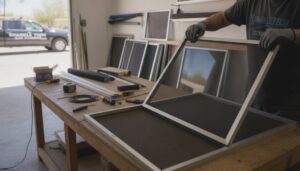
Mobile window screen repair is exactly what it sounds like: a trained technician drives directly to your home, fully stocked with tools, replacement mesh, and everything needed to complete the job on the spot. There is no storefront to visit, no awkward screen removal on your end, and no waiting around for days wondering when your screens will be ready. The technician shows up, assesses the damage, and gets to work right there in your driveway or yard.
Compare that to the traditional shop-based route, where you would need to pop out each screen yourself, load them into your car, drive to a repair shop, and then wait anywhere from several days to a couple of weeks for completion. For most homeowners, that kind of logistical back-and-forth is exactly the hassle they want to skip.
A typical mobile visit can cover quite a bit of ground in a single appointment. Services commonly handled on-site include window screen rescreening, screen door repair and replacement, solar screen installation, pet-resistant mesh upgrades, and even custom frame fabrication when a frame is too bent or warped to rescreen.
For Florida homeowners especially, mobile service makes a lot of practical sense. A single home might have a few screens that just need rescreening, one door that needs a full replacement, and a couple of windows that would benefit from solar screening for sun protection. One on-site visit handles all of it efficiently, rather than multiple trips to a shop.
The demand for this kind of doorstep convenience is growing fast, reflecting broader trends tracked in the door and window repair service market, which was valued at $82.4 billion in 2025 and is projected to reach $138.6 billion by 2034. Consumers across home services are consistently choosing on-location repair models because they value speed, simplicity, and same-week turnaround over the old drop-off-and-wait approach. You can explore additional context on this shift in the glass repair services market analysis, where mobile units for on-site repairs are now a recognized and growing service channel.
Repair, Rescreen, or Replace? How to Decide
Before you call anyone or spend a single dollar, it helps to understand the three possible outcomes for any damaged screen: a quick patch repair, a full rescreen, or a complete frame-and-mesh replacement. Knowing which category your screen falls into saves you from overpaying for work you don’t need.
Start With the 50% Rule
The simplest financial guideline in home repair applies perfectly here. If the cost to fix a screen creeps up toward 50% of what a brand-new replacement would cost, replacement is almost always the smarter move. This matters most on older frames where one problem often signals more are coming. Paying $40 to repair a screen that would cost $85 to replace outright rarely makes sense, especially when that “repaired” screen might need attention again next season.
Frame Condition Is Everything
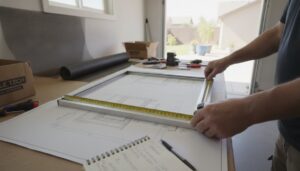
The single most important thing to check is the frame itself. Lay the screen flat on a solid surface and look at it honestly. Does it rock? Are the corners tight, or do you see gaps where the aluminum meets? Is the spline channel, the groove that holds the mesh in place, bent, crushed, or corroded?
A bent or warped frame simply cannot seat properly in your window track, even with brand-new mesh installed. Insect gaps will remain no matter how good the repair work is. If the frame has any of those issues, a full replacement is necessary regardless of what the mesh looks like. No amount of rescreening fixes a structurally compromised frame.
Three Scenarios, Three Solutions
Once you have assessed the frame, the right service usually becomes obvious:
- Small puncture or tear, frame is straight, rest of the mesh is solid. This is a patch or spot repair situation. A technician can address a small hole quickly, and you are done.
- Widespread mesh damage (multiple holes, brittleness, sagging) but the frame is straight and the corners are tight. This is a perfect rescreen candidate. The technician removes the old spline and mesh, cuts fresh material to fit, and presses new spline into the channel to lock everything in place. You get a like-new screen at a fraction of replacement cost.
- Bent, warped, or corroded frame with any level of mesh damage. Full frame-and-mesh replacement is the only sensible path. At this point, combined repair labor approaches the cost of a new screen anyway.
What to Expect to Pay in 2026
Having real numbers in mind before the technician arrives makes the whole conversation easier. According to the Window Screen Repair vs Replacement Cost Guide 2026, professional rescreening runs $45 to $85 per screen, while new standard replacement screens cost $70 to $120 installed. If you want to upgrade to solar mesh or pet-resistant material during a rescreen visit, expect to pay $150 to $300 or more professionally installed. That upgrade often makes excellent financial sense because the labor cost is already built into the service call.
The Full-House Math
Here is where strategy really pays off. A homeowner with 20 original screens who panics and replaces everything can easily spend over $2,000. But most homes do not need a one-size-fits-all approach. A smart technician will walk through each screen individually, identifying which ones need a patch, which are ideal rescreen candidates, and which frames genuinely need replacement. That mixed-service strategy, as outlined in this 2026 window screen replacement cost guide, routinely cuts the total project cost significantly compared to blanket replacement. You only pay for exactly what each screen actually needs.
Why Florida Homes Need Screen Repair More Often Than You Think
If you live in Florida, your window and door screens are working harder than you probably realize. The Sunshine State throws a combination of stressors at screens that simply does not exist in most other parts of the country, and that relentless exposure adds up faster than most homeowners expect.
Start with UV exposure. Florida’s sun beats down year-round, not just in summer, and that constant radiation gradually dries out screen mesh, fades the material, and makes fiberglass brittle over time. Add coastal salt air into the mix, and aluminum frames in waterfront communities can show serious corrosion in as little as 10 to 12 years. High humidity compounds the problem by wearing down spline rubber and promoting frame oxidation even on inland properties. Then factor in hurricane season, where strong winds and flying debris can loosen fasteners, buckle frames, and punch through mesh in a single storm. You can learn more about how Florida weather affects your screens to get a clearer picture of what your screens are up against every single year.
Here is the part that catches most homeowners off guard: UV damage is invisible until it is not. Mesh that looks perfectly fine from across the room can be so brittle that it tears under light finger pressure. Because sun exposure is uniform across your whole house, you rarely end up with just one bad screen. You typically discover several failing at once, which is exactly why a whole-home mobile assessment makes so much practical sense.
Homes that are 10 or more years old with their original screens almost always present a mixed picture. One window might need a simple rescreen, the one next to it might have a frame too bent or corroded to reuse, and the sliding screen door off the lanai probably needs new rollers on top of fresh mesh. A single mobile visit can triage all of it efficiently, rather than scheduling separate appointments over several weeks.
Two upgrades are worth knowing about before your technician arrives. Solar screens block up to 90% of solar heat before it ever reaches the glass, which directly reduces cooling loads and lowers utility bills. This is a meaningful upgrade in a state where air conditioning runs most of the year. Pet-resistant mesh is the other standout option, especially for lanais, pool enclosures, and sliding doors. It is a heavier vinyl-coated polyester that costs more upfront but holds up far longer in high-traffic spots where standard fiberglass tears repeatedly. For a closer look at screen repair options after storm damage, including specialty materials available beyond standard mesh, that resource covers the range of choices worth discussing with your technician.
Professional Mobile Repair vs. DIY: An Honest Comparison
Let’s be honest: the DIY option looks pretty attractive when you’re staring at a torn screen. A patch kit costs $5 to $15 at any hardware store, and even a full DIY rescreen with new mesh and spline typically runs under $40 per screen in materials. On paper, that’s hard to argue with.
The reality, though, is that most first-time DIY rescreens don’t go as smoothly as the packaging suggests.
Where DIY Tends to Break Down
The two most common failure points are frame seating and spline tension. Getting the spline seated evenly around the entire frame perimeter takes practice and the right roller tool. Without both, mesh pulls unevenly, corners pucker, and spline pops loose in spots. The result is a screen that looks okay at first glance but starts admitting bugs or sagging away from the frame within a season, especially under Florida’s combination of intense UV exposure, humidity, and afternoon storms.
Frame condition makes this worse. If the frame is even slightly bent or warped, no amount of careful rolling will produce a flush, bug-proof fit. That’s a structural problem that mesh and spline simply can’t fix.
What a Professional Mobile Technician Actually Brings
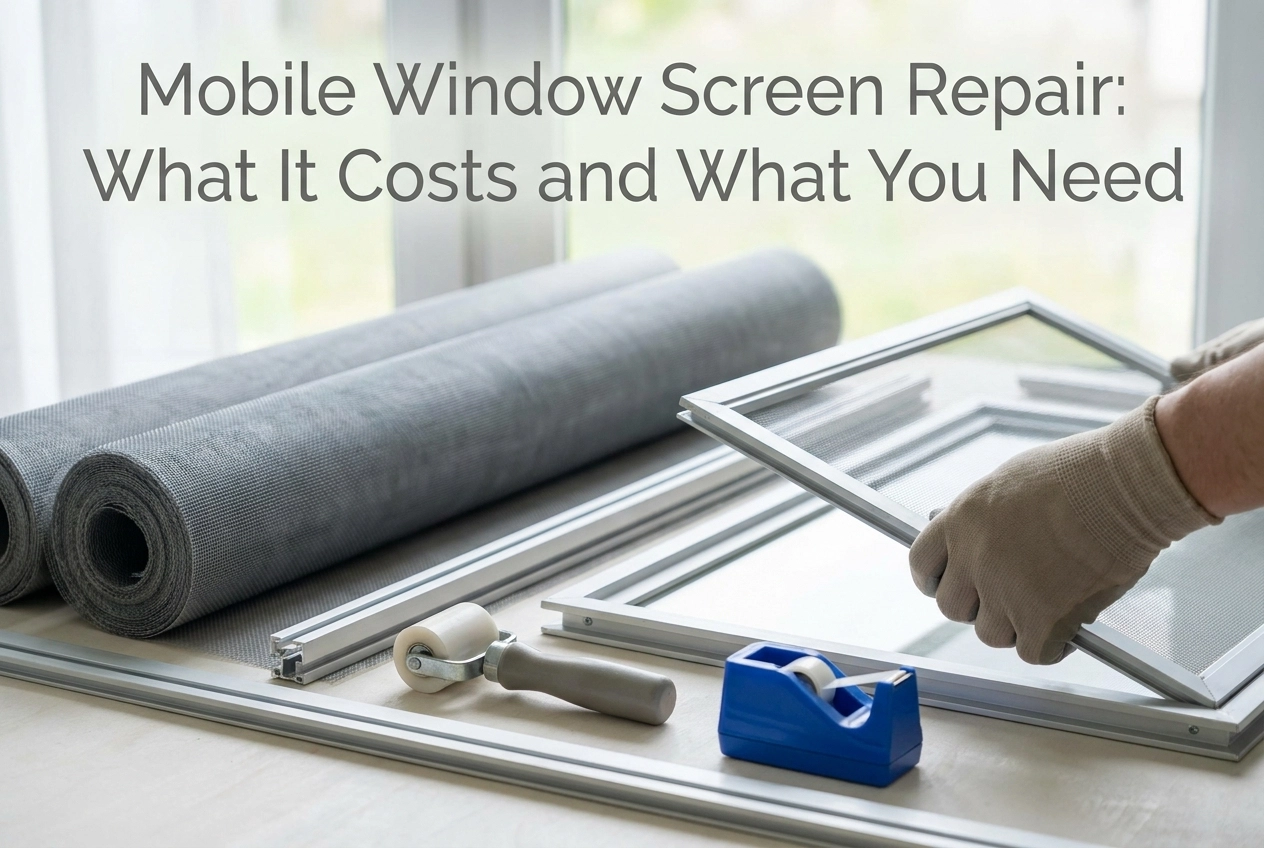
A trained mobile technician arrives with commercial-grade spline rollers, mesh pre-cut to your exact frame dimensions, and spline matched to the correct diameter for your frame channel. That last detail matters more than most people realize: wrong-diameter spline seats loosely and works free over time. The time and quality differences between professional and DIY screen repair are significant, particularly for homeowners tackling multiple screens.
Speed is also a real factor. A technician can rescreen a standard window in under 15 minutes on-site. A first-time DIY attempt on that same screen commonly takes an hour or more, with a meaningful chance of needing to redo it.
The Honest Bottom Line
DIY is a reasonable call for a single small puncture on an accessible screen where a patch kit will hold. For anything beyond that, including whole-home rescreening, screen doors, aging frames, or solar mesh installation, professional mobile service delivers better value once you factor in your time, the risk of redoing work, and how long the finished product actually lasts.
What to Expect from a Mobile Screen Repair Visit
Knowing what happens during a mobile screen repair visit makes the whole experience less stressful, especially if you’ve never booked one before. Here’s how a typical visit flows from start to finish.
Step 1: Book Your Appointment
The process starts with a quick phone call or online booking. With Sparkle Tech Sunscreens, same-week availability is a standard part of how the service works, not a premium upgrade you have to ask for. Most homeowners can lock in an appointment within days, not weeks, which matters a lot when a torn screen is letting bugs into your living room every evening.
Step 2: The Whole-Home Assessment
When the technician arrives, they don’t just look at the one screen you mentioned. They walk the entire home and evaluate every screen, checking mesh condition, frame integrity, and spline wear on each one. You’ll get a clear breakdown of what needs patching, what needs rescreening, and what needs a full frame replacement, along with costs for each option, before any work begins. Nothing gets touched until you’ve approved the scope.
Step 3: On-Site Repair, Start to Finish
Everything needed to complete the job comes loaded in the technician’s vehicle. Mesh materials, spline, replacement frames, and fabrication tools are all on board, so repairs and rescreens happen during the same visit. No parts get ordered. No return trips are scheduled just to finish what was started. Most individual window rescreens take roughly 15 to 30 minutes each.
Step 4: Add Screen Cleaning While You’re At It
If your screens have been collecting dust, pollen, or oxidation, a professional cleaning during the same appointment is an easy way to protect your investment. This matters especially for solar screens, which rely on clean mesh to perform properly. Dirty mesh reduces the screen’s ability to block heat and accelerates wear over time. Bundling cleaning with your repair visit saves you from scheduling a separate trip later.
Step 5: The Final Walkthrough
Before the technician leaves, you’ll get a quick walkthrough of everything completed. They’ll also share care tips specific to the mesh types installed, whether that’s standard fiberglass, solar-grade mesh, or another material. There’s no shop drop-off, no pickup coordination, and no waiting around. The job is done, and your home is back to normal before the technician pulls out of your driveway.
Frequently Asked Questions About Mobile Screen Repair
How Long Does a Mobile Visit Take?
Most individual rescreens take roughly 10 to 20 minutes per screen once the technician is on-site and set up. If you have a whole-home visit covering multiple windows plus a screen door, plan for somewhere between one and three hours total, depending on how many screens need attention and what type of work each one requires. It moves faster than most people expect, and you can go about your day while the technician works.
Can You Repair Just One Screen?
Absolutely. There is no minimum order, and a single torn or sagging screen is a perfectly valid reason to book a visit. That said, it is worth mentioning that a good technician will often do a quick visual scan of your other screens while on-site. This takes just a few extra minutes and can reveal screens that are close to failing but not quite there yet. Catching those early means you handle them on your schedule rather than scrambling after the next storm rolls through.
Do Mobile Technicians Handle Screen Doors?
Yes, screen doors are one of the most common requests. Worn rollers, bent frames, torn mesh, and doors that jump off their track are all handled during a standard mobile visit. If your sliding screen door has been dragging, sticking, or simply refusing to glide smoothly, that is squarely within scope.
What About Solar Screens?
Solar screens are measured, cut, and installed completely on-site. They block somewhere between 65 and 90 percent of heat before it enters your home, and they come in different densities depending on how much sun a given window receives. No second trip needed.
Can HOAs and Rental Properties Use This Service?
Yes. Sparkle Tech Sunscreens works with property managers, HOAs, and multi-unit residential clients, not just individual homeowners. If you manage a property with ongoing screen maintenance needs, it is worth asking directly about bulk scheduling or recurring service arrangements to keep everything running efficiently.
Ready to Stop Putting Off That Screen Repair?
By now, you’ve got a solid framework for making the right call on any screen. Check the frame first; if it’s bent or warped, replace the whole unit. If the frame is solid and only the mesh is torn, a rescreen is usually all you need. And if repair costs are creeping toward 50% of full replacement cost, go ahead and replace it. The good news is that a mobile visit handles all three scenarios in a single stop, even when different windows need different solutions.
Same-week availability matters more than it sounds. Hauling screens to a shop means multiple trips and days of waiting. Booking through a larger franchise often means a scheduling window that stretches out a week or more. With Sparkle Tech Sunscreens, you get a technician at your door this week, not next month.
While the technician is already on-site, pairing a screen cleaning with your repair visit is a smart move. Clean screens perform better, and for solar screens specifically, removing built-up dust and debris helps maintain their heat-blocking performance over time.
Ready to get a clear picture of what your home actually needs? Contact Sparkle Tech Sunscreens to book a same-week mobile assessment and skip the guesswork entirely.
Conclusion
Dealing with a damaged window screen doesn’t have to be a source of stress or a drain on your wallet. Here’s what to keep in mind as you move forward:
- Mobile window screen repair is affordable and accessible for most homeowners
- Basic DIY repairs require minimal tools and materials
- Knowing when to hire a professional can save you time and frustration
- Acting quickly prevents bigger problems like pest intrusion and poor ventilation
Now that you have a clear picture of what repair costs and what the process involves, it’s time to take action. Assess your screens today, gather your materials, and get started. If the damage feels beyond your skill level, don’t hesitate to call a trusted local repair service. A fully functioning window screen is a small fix that makes a big difference in your daily comfort and peace of mind.