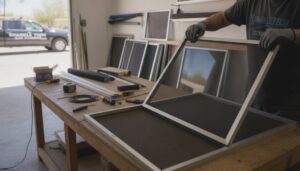

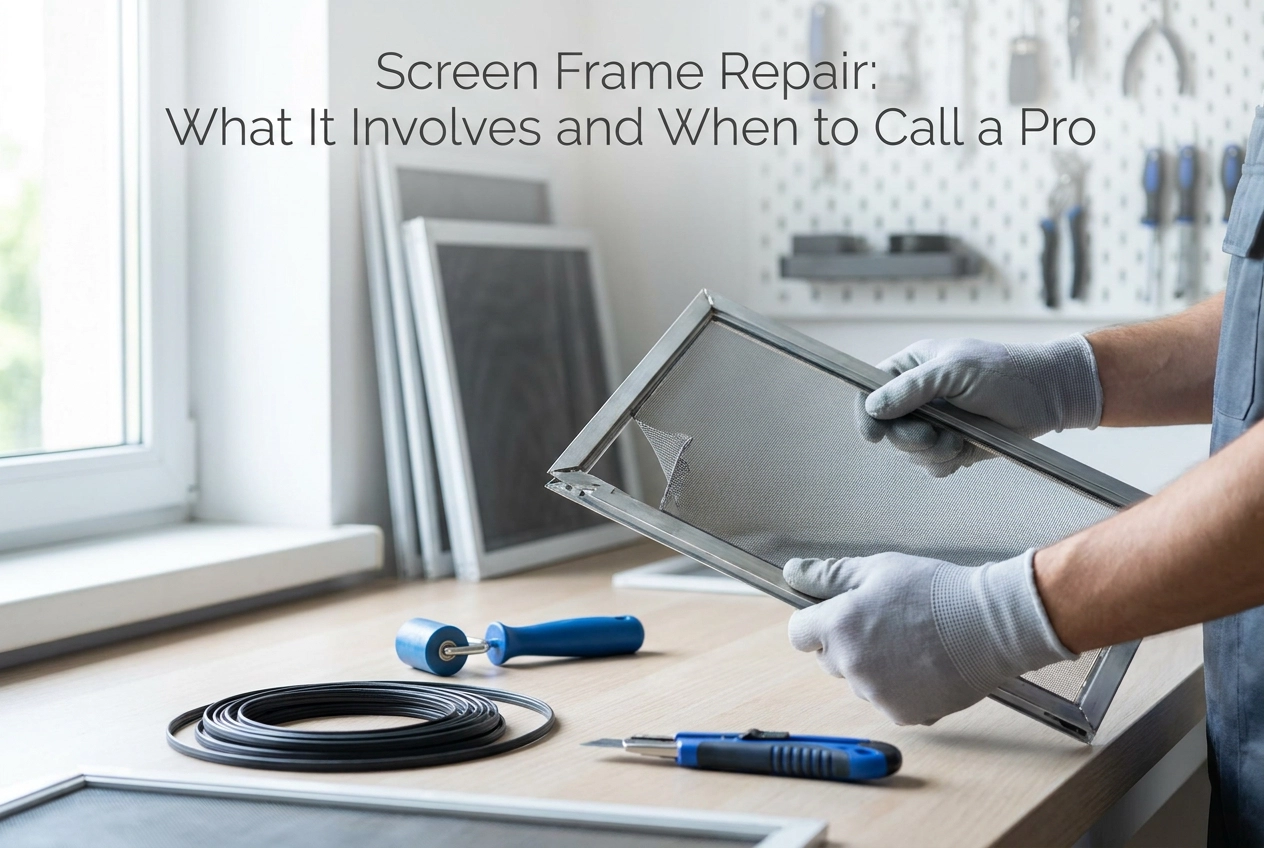

There is nothing quite like a torn or bent window screen to let in all the bugs you were trying to keep out. If your screen is looking a little rough around the edges (literally), you might be wondering whether it is time to toss the whole thing or if a simple fix will do the trick.
Good news: screen frame repair is often easier than it looks, and in many cases, you do not need to be a handy person to tackle it yourself. Whether you are dealing with a bent aluminum frame, a corner that has popped apart, or a screen that keeps pulling away from its groove, there are straightforward solutions worth knowing about.
In this guide, we will walk you through what screen frame repair actually involves, the basic tools and materials you will need, and the most common fixes you can try at home. We will also help you figure out when a problem is better left to a professional. By the end, you will have a clear picture of exactly what to do next.
What Screen Frame Repair Actually Involves
When most people hear “screen frame repair,” they picture patching a hole or swapping out torn mesh. The reality is a bit more layered than that, and knowing the difference upfront will save you time, money, and a second service call.
Screen frame repair actually covers four distinct types of work. Re-cornering means reconnecting or replacing the small corner keys that hold the mitered frame sections together. Spline replacement involves pulling out the rubber cord that locks the mesh into the frame channel and seating a fresh one. Frame straightening means carefully bending a warped aluminum frame back to its original flat geometry. And full reframing means building an entirely new frame when the existing one is too far gone to save.
Re-cornering is the most common repair homeowners run into. Those little plastic or aluminum corner keys are under constant stress from door slams, pressure washing, and the natural expansion and contraction that comes with temperature swings. Over time, they crack or pop loose, and suddenly your frame sits at an odd angle or won’t lie flat in the opening.
Here is the part that surprises most people: spline replacement usually needs to happen alongside frame repair. If the frame was compromised, the spline groove almost certainly took some damage too. Reinstalling mesh into a repaired frame without replacing the spline produces a saggy, uneven screen that pops out again within weeks.
This is a well-established service category, not a niche fix. The global door and window repair market was valued at $82.4 billion in 2025 and is projected to reach $138.6 billion by 2034. Understanding which specific repair your frame needs helps you describe the problem clearly, set realistic turnaround expectations, and avoid paying for work you do not actually need. For a helpful visual reference on how screens are built, Working with Screens breaks down the components in plain terms.
Repair vs. Replace: How to Make the Call
So now that you understand what screen frame repair involves, the next question is the one that actually costs people money when they get it wrong: do you repair what you have, or do you replace it entirely?
The good news is that repair is almost always the right first move. If your mesh is torn but the aluminum frame sits flat, the corners are still tight, and the channel groove that holds the spline is clean and undamaged, you are looking at a re-screening job rather than a full replacement. Frames under 10 years old almost always fall into this category. Replacing a structurally sound frame just because the mesh gave out is like buying a new car because a tire went flat. It wastes money and generates material waste that could have been avoided entirely.
That said, there are clear situations where the frame itself needs to go. If the aluminum is sharply kinked and will not straighten, if the spline channel is crushed so badly that new spline will not grip, if corrosion has eaten into the frame structure, or if the frame has warped so much that it no longer fits squarely in the opening, re-screening over that frame is just delaying the inevitable. According to a window screen repair vs. replacement cost guide for 2026, a useful financial benchmark is the 50% rule: if repair costs exceed half the price of a full replacement, replacing the frame is the smarter investment.
The broader trend backs this up. North America accounts for 34.1% of the global door and window repair services market, and homeowners across the region are increasingly choosing repair over replacement as new installation costs continue to climb. Aging housing stock is one of the primary demand drivers pushing this shift, meaning millions of homes have frames that are perfectly repairable but simply neglected.
Before you call anyone, run this quick self-check. Pull the screen out and lay it on a flat surface. Ask yourself three questions: Does the frame lie flat without rocking? Is the damage limited to one section rather than spread across the whole frame? Is it aluminum rather than cracked vinyl? If you answered yes to all three, repair is almost certainly your path, and a professional assessment can confirm it fast.
How Frame Material Affects Repairability
Not all screen frames are created equal, and the material your frame is made from has a direct impact on whether repair is even an option. Understanding the basics here can save you from guessing when something goes wrong.
Aluminum: The Most Repair-Friendly Option
Aluminum frames are the go-to material in residential screen repair, and for good reason. The metal is malleable enough to be gently straightened under moderate force without cracking or splitting. Corner keys, the small plastic connectors that hold frame sections square at each joint, are widely available in standard sizes and easy to swap out. The spline channel in most aluminum frames is also deep enough to re-engage properly after the frame has been realigned. If you have a twisted or slightly bent frame sitting in your garage right now, there is a good chance it is aluminum, and a good chance it is repairable.
Vinyl and Composite Frames
Vinyl frames behave very differently under stress. Instead of bending, vinyl tends to crack when force is applied. Once a vinyl frame section cracks, it cannot be straightened back into shape; that section needs to come out entirely. That said, if the vinyl rails themselves are still intact and only the corner connector has given out, a corner re-key can sometimes rescue the frame without full replacement.
Fiberglass composite frames, which show up occasionally in premium window assemblies, are generally not field-repairable the same way aluminum is. If the frame profile itself is damaged, replacement is usually the more practical path.
A Note on Aluminum Gauge
Even within aluminum frames, thickness matters. Standard residential frames use a thinner gauge that bends easily and straightens just as well. Heavier frames found on large picture windows or commercial screens are more resistant to damage upfront, but when they do bend, realigning them takes more force and sometimes specialized tools.
You do not need to know your frame material before calling for service. A qualified technician can identify material type and assess repairability on sight during the initial visit, which is exactly why scheduling an on-site evaluation is always a worthwhile first step.
Screen Door Frames vs. Window Frames: Key Differences
Not all screen frames face the same daily demands, and this difference matters a lot when you’re trying to figure out what kind of repair you actually need.
Screen door frames take a beating that window frames simply don’t. Every time someone opens and closes the door, that motion applies lateral force directly to the frame corners. A door that gets slammed, or one pulled shut repeatedly by a pneumatic closer, concentrates that stress at the top and bottom corners cycle after cycle. Window screen frames, by comparison, mostly just sit there. They rest in a track, stay put, and experience very little repeated mechanical pressure. That’s a fundamentally different life for the same basic material.
Door frames also carry hardware that window frames don’t have to deal with. Handle sets, latches, and closers all mount into or alongside the frame, and when any of that hardware shifts or misaligns over time, it can actually torque the frame out of square. This is why simply re-keying the corners of a door frame often isn’t enough on its own. If the hardware alignment problem isn’t corrected first, the frame will just work itself out of shape again.
Thermal movement adds another layer of complexity. Aluminum expands in summer heat and contracts on cooler nights, and a screen door has to clear a track and latch precisely every single time. A professional repair accounts for that movement rather than just forcing a bent frame back into a tight opening.
If your screen door is dragging along the bottom, catching on the track, or showing a gap at one corner even when fully latched, those are signs the frame is out of square. New mesh won’t fix that. The frame itself needs professional realignment first. Understanding how different mesh materials interact with frame hardware can also help you make smarter choices once the frame is properly squared up again.
Solar Screen Frames Deserve Special Attention
Solar screens are a different animal compared to standard bug screens, and that difference matters a lot when you’re thinking about frame repair. The mesh used in solar screens, typically rated at 80% or 90% solar block, is heavier and denser than the lightweight fiberglass used in regular insect screens. That extra weight puts significantly more tension on the frame corners and spline channel. A frame that’s holding up just fine under a standard bug screen mesh might actually buckle, bow, or separate at the corners once heavier solar fabric is installed. If your solar screen frame is already showing early signs of wear, that’s worth taking seriously sooner rather than later.
When a solar screen frame is compromised, you lose on two fronts at the same time. Gaps at corners or along a warped edge let insects through, which defeats the pest exclusion purpose entirely. At the same time, a bowed or sagging frame allows the solar mesh to pull away from the window opening, and once that mesh loses its tension, its ability to block heat and UV drops noticeably. According to Phifer, solar screens can block up to 80-90% of the sun’s heat before it ever reaches the glass, but that performance depends entirely on a properly tensioned screen sitting flush against the window.
One detail that trips up a lot of DIYers is spline sizing. The spline used for lightweight bug screen mesh is often too thin to hold heavier solar fabric securely in the channel long-term. Using the wrong spline size means the mesh can work loose over time, even if the repair looks fine initially. Getting this detail right is one of the stronger arguments for having a professional handle solar screen frame repairs.
If your solar screens already need a frame repair, that visit is also a smart time to have the mesh itself evaluated. Combining a frame repair with a mesh assessment keeps your total service cost efficient and extends the life of the whole assembly, rather than addressing each issue in separate trips.
What to Expect from a Professional Screen Frame Repair Visit
When you book a professional screen frame repair visit, knowing what happens step by step makes the whole experience less stressful, especially if it’s your first time.
The Four-Step Repair Sequence
A well-run visit follows a predictable sequence. First, the technician does a visual and physical assessment of your frame, checking whether the corners are square (meaning the frame forms true right angles and will seat flush in the opening), inspecting the condition of the corner keys (the small plastic or metal inserts that lock each corner joint together), measuring channel depth, and evaluating the existing mesh. Second, they give you a clear recommendation: repair the current frame, rescreen with the same frame, or replace the frame entirely. Third, the actual repair happens, typically right in front of you. Fourth, there’s a fit check where the technician confirms the screen seats correctly in the opening before packing up.
On-Site Service and Why Scheduling Speed Matters
On-site repair has become the preferred model for most homeowners because you don’t have to wrestle a large sliding door screen or a set of multi-panel window screens into your car. You can watch the work, ask questions, and approve the result on the spot. That said, some shop-based providers argue their equipment produces cleaner results for complex jobs, so it’s worth asking your provider which approach they use and why.
Scheduling speed matters more than most people realize. A torn screen door in July isn’t a cosmetic problem; it’s an open invitation for mosquitoes and other pests every time someone walks through. Waiting weeks for an appointment means dealing with that problem every single day. Sparkle Tech Sunscreens offers same-week service specifically because that gap between damage and repair is where the frustration builds fastest.
Photo Assessment and the Post-Repair Checklist
Many repair providers now accept photos of your damaged frame before the visit. Submitting a clear photo lets the technician arrive with the right corner key sizes, spline diameter, and mesh type already loaded, which significantly reduces the chance of a return trip.
Before your technician leaves, walk through a quick quality check together. Press lightly at each corner to confirm the corner keys are fully engaged. Run a finger along the spline channel to make sure the spline sits flush with no gaps or lifted sections. If it’s a door frame, open and close it several times to confirm it tracks smoothly and latches correctly. A confident technician will welcome this, not rush past it.
Cost and Turnaround: What Homeowners Can Realistically Expect
Three factors drive what you’ll actually pay for screen frame repair: the type of repair needed, the size of the frame, and the mesh type involved.
Repair type has the biggest impact on your total. A corner re-keying job, where a technician simply rejoins separated corner keys without replacing any frame extrusion, sits at the lowest end of the cost range. A full reframe with new mesh sits at the top. Frame size is the next variable; a standard 3×5 window screen costs noticeably less to reframe than a 6-foot sliding screen door, both in materials and labor time. Mesh type matters most when a mesh replacement is bundled with the frame work. Standard fiberglass bug screen is the most affordable option. Solar mesh, which can block 70 to 90 percent of solar heat gain, runs higher, with professionally installed solar screens typically ranging from $120 to $400 per screen depending on size.
Even at the higher end of that range, professional repair is almost always substantially less expensive than purchasing and installing a brand-new screen door or window screen assembly.
Turnaround time is where local mobile providers genuinely stand out. A specialist with on-site service and a stocked parts inventory can often complete standard frame repairs in a single visit, with same-week scheduling available rather than the longer lead times common with larger organizations.
Two practical tips worth remembering: first, ask upfront whether your quote covers both the frame repair and mesh replacement if both are damaged, since bundling them in one visit saves you money. Second, if you have several screens with frame issues, mention all of them when booking. A multi-screen visit is almost always priced more efficiently per screen, and it gives your technician time to bring the right materials for every unit.
The Bottom Line on Screen Frame Repair
Here is the bottom line, and it is genuinely good news for most homeowners: the damage you are looking at is probably fixable. Bent corners, popped splines, and warped edges are the most common screen frame problems, and in most cases they respond well to targeted repair rather than full replacement. The key is acting early. A bent frame that is ignored will stop seating properly, creating gaps that let insects in and, for solar screens, reducing the energy performance you are counting on. A small problem that gets attention quickly stays a small problem.
Material matters when making your call. Aluminum frames are the most forgiving and can often be re-screened even after years of use, as long as the frame stays square. Vinyl and composite frames need a case-by-case look. Screen door frames carry extra mechanical stress from daily use, so alignment is just as important as the mesh or corners. And solar screen frames require precise spline sizing and proper mesh tension to do their job correctly. Getting those details right is the difference between a specialist and a general fix-it approach.
The repair-before-replace mindset saves money, cuts down on waste, and typically gets your screen back to full function within days. When you are ready to move forward, Sparkle Tech Sunscreens offers professional screen frame repair with same-week availability and on-site service. Snap a few photos of the damage before you call or book online so the technician arrives fully prepared to get the job done in a single visit.
Conclusion
Screen frame repair does not have to be overwhelming. With the right knowledge, most homeowners can handle bent frames, loose corners, and sagging screen mesh without spending a lot of money or calling for help. The key takeaways are simple: assess the damage first, start with the least invasive fix, use the correct tools and materials, and know your limits when the damage is beyond a quick patch.
When in doubt, a professional can save you time and frustration, especially for custom frames or structural damage.
Ready to get started? Take a close look at your screen today, identify the problem, and use this guide as your roadmap. A little effort now means fewer bugs inside and more peace of mind all season long. Your screens are worth fixing right.